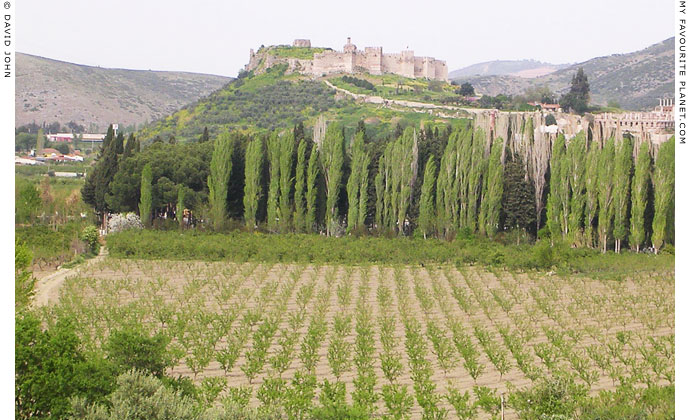
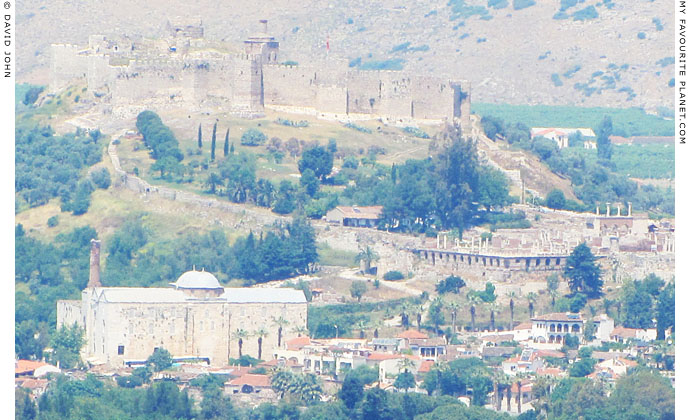
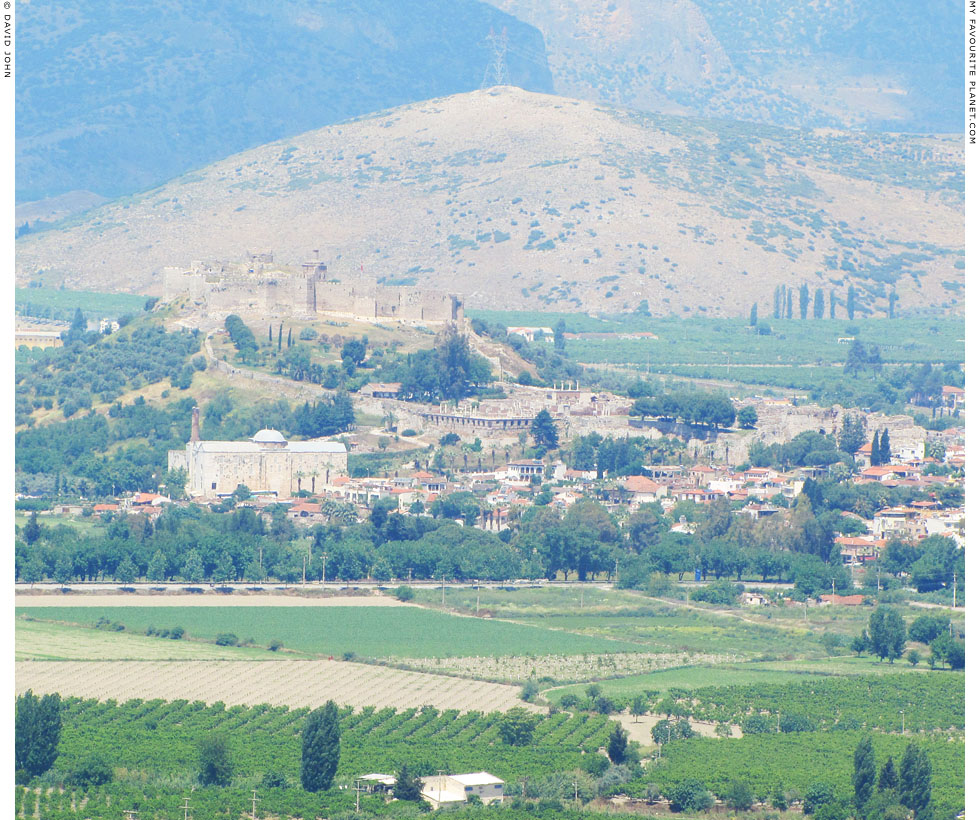
The Isa Bey Mosque (Isa Bey Camii, built 1375, see also photo 15) is in the background left. Behind it stands the Byzantine citadel (acropolis) of Ayasuluk, which due to its use by the military, can not be visited. Along the hill to the right of the citadel are the ruins of the Basilica of Saint John.
 It may be difficult to believe from its sorry state, but the Temple of Artemis, the Artemesion, was once one of Philo of Byzantium's Seven Wonders of the World. The first known mention of this list of sights was by the Greek epigrammatist Antipater of Sidon (2nd century AD) who wrote:
| |
 I have set eyes on the wall of lofty Babylon, on which there is a road for chariots, and the statue of Zeus by the Alpheus, and the hanging gardens, and the Colossos of the Sun, and the huge labour of the high pyramids, and the vast tomb of Mausolus, but when I saw the house of Artemis that mounted to the clouds, those other marvels lost their brilliancy, and I said. "Lo, apart from Olympus, the sun never looked on anything so grand."
 Antipater of Sidon (Greek Anthology 9.58)
 |
The cult of the fertility and earth-mother goddess Artemis in Anatolia and Greece goes back into prehistory. In Ionia she is often referred to as Cybele-Artemis, since following the arrival of the Ionian Greeks here around 1000 BC, she supplanted or assimilated the ancient Anatolian mother goddess Cybele. Archaeologists have dated the oldest known Artemis sanctuary on this site to the 8th century BC. This seems to have been destroyed during Cimmerian invasions in the 7th century BC.
 Its replacement, designed by Cherisphron in the form of an Ionic dipteros (completely surrounded by a double row of columns), was completed in 550 BC, took 120 years to build, was the first monumental building made entirely of marble, and at that time the largest in structure the Greek world. Many of its columns, decorated with reliefs, were paid for by the fabulously rich King Croesus of Lydia, who was half Greek and ruled parts of Anatolia 560 - 546 BC. This "old" or "archaic" temple was destroyed by a fire in 356 BC (on the night of Alexander the Great's birth), allegedly started by Herostratus, who is said to have claimed to have done the deed in order to achieve eternal fame. He seems to have been successful so far.
 The Ephesians started work on a new, even more magnificent Ionic temple soon after, completing it in the early 3rd century BC. This is the structure whose remains we see today. Alexander the Great sacrificed at the building site of the temple when he passed through Ephesus in 334 BC and offered to pay for its completion himself, but the Ephesians politely refused his offer.
 This enormous building was around 105 metres long, 55 metres wide and 20 metres tall, with a roof supported by 127 columns. It was plundered by Nero, and then destroyed by the Goths when they sacked Ephesus in 263 AD. It was later partly rebuilt, but destroyed again in 401 AD on the order of Saint John Chrysostom, archbishop of Constantinople and great opponent of the pagan religions.
 (Many internet sources slavishly copy each other in citing John Freely as writing that the Temple of Artemis was destroyed "by a mob led by St. John Chrysostom". (John Freely, The western shores of Turkey: discovering the Aegean and Mediterranean coasts, 2004). John Freely is an acknowleged expert on Turkish history, and can be usually depended on for accurate, interesting and well-written information. However, we have so far found no other reference to Chrysostom's direct action in the destruction. In his splendid book The companion guide to Turkey (1979), Freely makes no mention of this incident.)
 What little remained was finally abandoned and left to rot after the cult of Artemis was supplanted by Christianity. Over the centuries its remains were used as building material by the Byzantines, who used many of the temple's columns for the construction of Aghia Sophia in Constantinople.
 Much later still some the archaic temple's reliefs and decorated columns (one of which thought to have been designed by Scopas) were carted of to the British Museum. Because of the extensive excavations here by British archaeologists, begun in 1869 by John Turtle Wood, locals named the site of the temple "the British hollow". |
|
|