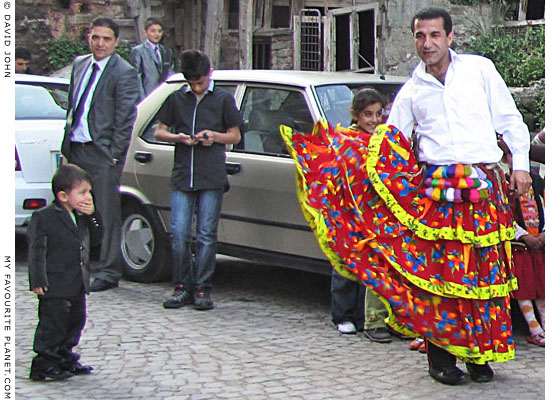
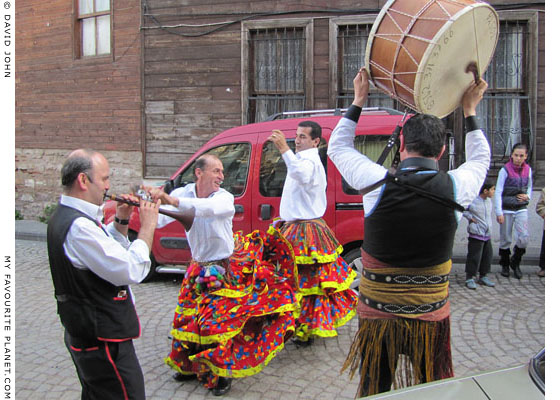
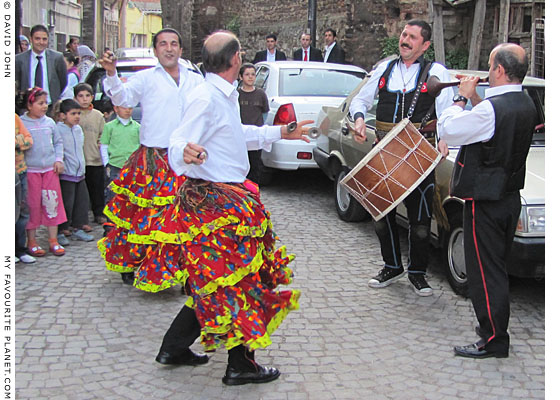
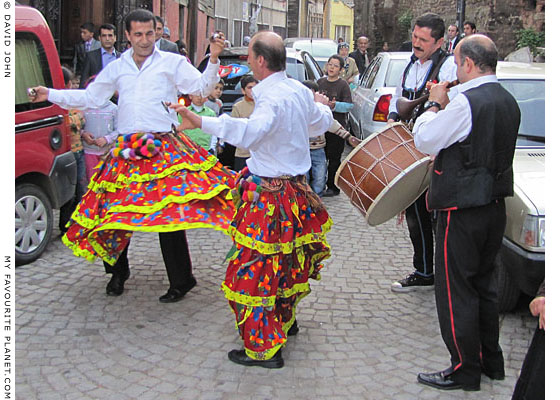
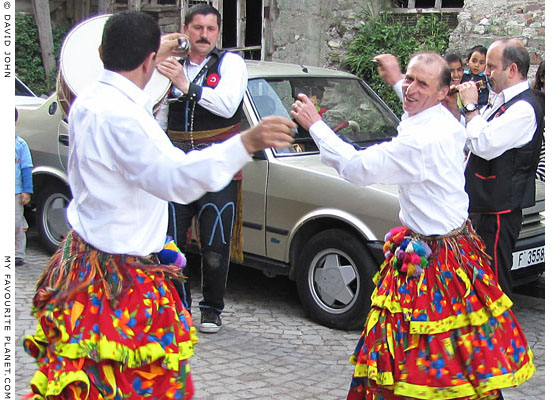
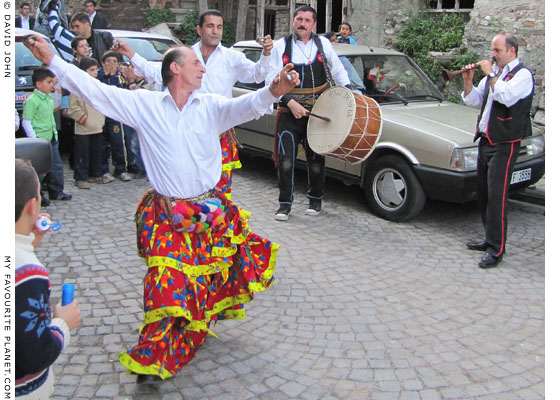
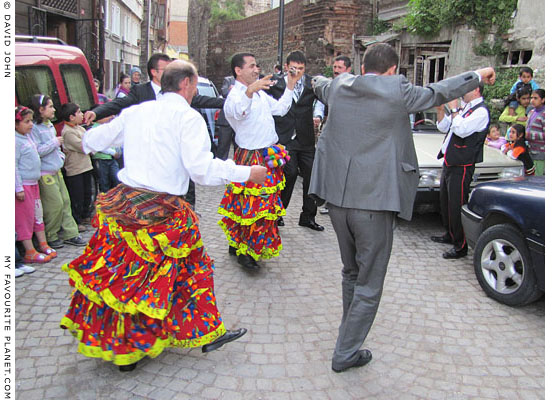
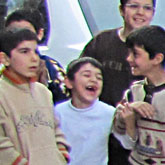
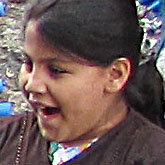
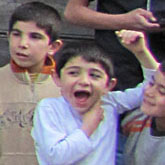
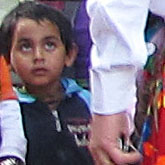
While wandering the narrow streets around the 12th century Byzantine Church of Christ the Pantocrator (Molla Zeyrek Camii) in Istanbul's Fatih district, I was taken by surprise when a group of wedding guests suddenly appeared, a car arrived, two dancers, wearing bright red and yellow skirts, and two musicians got out and started performing immediately and without further ado.
The dance was sprited, energetic, playful and flirtatious. One of the dancers would approach a wedding guest who held out a bank note. The dancer would then perform various acrobatic bends and girations around them before taking the note - sometimes between his teeth.
Everybody was happy and friendly, and they indicated that I should use my camera. So I did. The adults took part in the fun, mostly unselfconsciously, while the younger children reacted to the whole spectacle with amazement or uncontrolled laughter and excitement.
Then, as suddenly as they had arrived, the show was over, the performers got back into their car and disappeared again. Perhaps they were off to the wedding reception, or even to the next wedding.
Later, I discovered that this dance belongs to the Köçek tradition.
Just about every region and village in Turkey has its own dance traditions, including those of ethnic minorities such as Kurds, Arabs, Armenians, Gypsies and Greeks. There are also dances imported from other countries as well as those developed as entertainment for the general public and Ottoman courts. According to Turkish author Professor Metin And [1], there are around 1500 different village dances in Turkey, many with ancient roots, in the form of pantomime depicting village life, nature, combat and courtship.
If anybody knows more about this dance or the dancers, I would love to hear from you. See the contact page.
You only have to watch the video see how skilled, energetic, dramatic and humorous these practitioners of this dance form are. I was very
impressed and entertained, and would be delighted not only to see them perform again but also to discover more about their art.
For further information about Köçek dance, see the links [note 2] below.
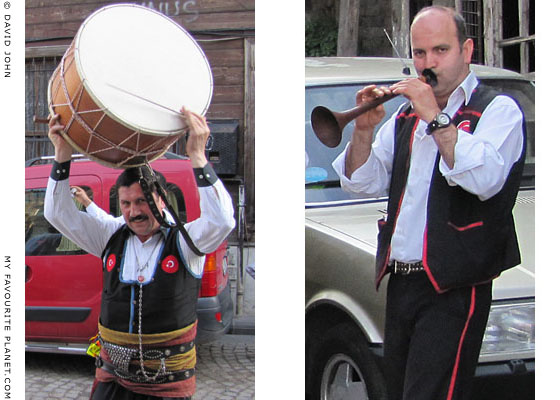
The musicians playing the davul (left) and zurna (right), traditional Turkish instruments.
The davul (also known as tapan or tupan, from the Greek tympano, and by many other names in various countries and regions) is a large, hand-held, double-sided drum, used in tradtional music in Turkey, Central Asia, the Levant, North Africa, the Balkans and Greece. Made with a hardwood drum shell and animal skin heads, designed and stretched so that one side produces a deep bass and the other a treble sound. Various types and thicknesses of dumsticks are also used to produce different tones and effects.
The zurna is a conical, double-reeded, woodwind instrument, similar to the oboe and Armenian duduk (a straight instrument with a history of at least 1,500 years).
Made of apricot wood, zurnas are found in many sizes, and like the davul, are used in many countries.
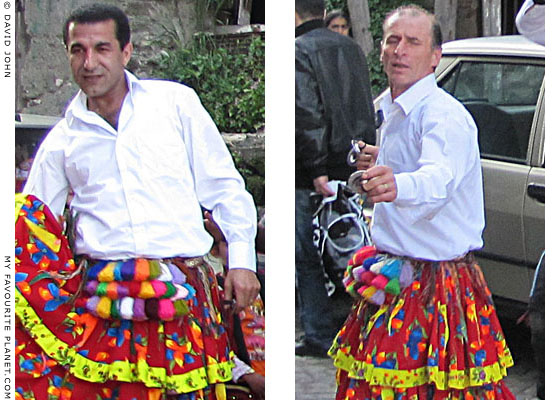
The Köçek dancers themselves also wear finger cymbals, known in Turkish as zil.
Köçek dancers and musicians at a wedding celebration in Istanbul's Fatih district.
Ibadethane Sok, Kücükpazarthe, near the Church of Christ the Pantocrator (Zeyrek Camii).
Swing them hips!
That's the way you do it.
What do you think of the show so far?
Lightly gliding across the cobblestones.
Everybody dance now.
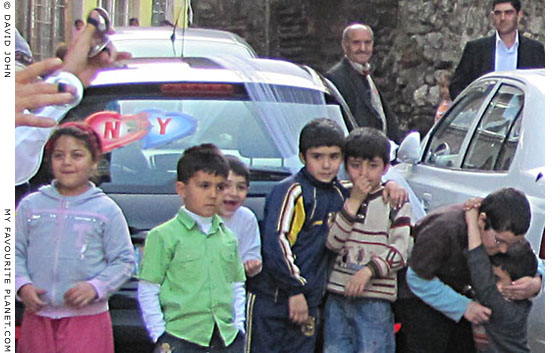
Audience reaction.
The reactions of the children to the dancing spectacular were varied. Generally, the girls were enchanted and delighted by the dancers' graceful movements, athletic antics and theatrics. The younger boys were openly astonished - shocked even - by the sight of men prancing around in gaily-coloured skirts; an amazement which turned to uncontrolled laughter. The older lads were not at all sure what to make of it, or whether they ought to show their inner reactions: a mix of bewilderment, incredulity and scepticism.
As in any big city, the pace of change is rapid in Istanbul. The lifestyle of young people here is very different to that of their parents, grandparents or even cousins in Turkey's villages. Contact with foreigners as well as the influence of television, the internet and other trappings of modern life have changed people's interests, tastes and priorities. Fewer youngsters show an interest in carrying on folk traditions. It was notable that apart from members of the wedding party, all the spectators in the street were children, middle-aged and older locals: no young adults were to be seen. Folklore? Seen that, been there. One wonders if these children will be able to call on the services of such dancers at their own weddings.
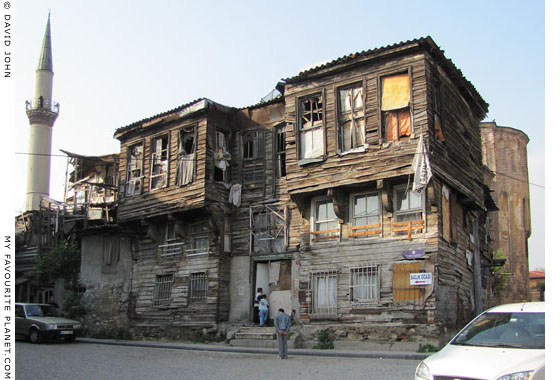
Dilapidated old wooden house in front of the Molla Zeyrek Mosque, Fatih district.
Families actually live in this wreck, and other constructions in even worse condition. Unfortunately, renovation would lead to higher rents,
which few of the families could afford. Many such houses are simply squatted by people who scrape together a living on the streets.
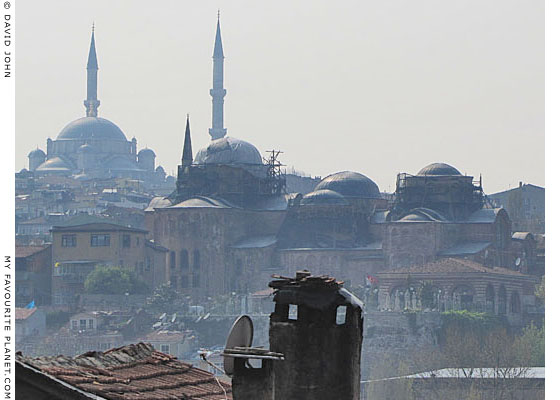
Molla Zeyrek Camii, formerly Church of Christ the Pantokrator (12th century), as seen from the Vefa district, with the Fatih Camii (18th century) in the background.
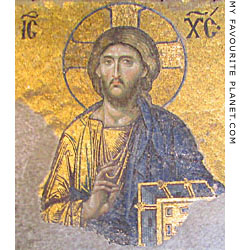
Christ the Pantocrator mosaic, Hagia Sofia, Istanbul
The complex is currently closed for much-needed renovation which will take several years.
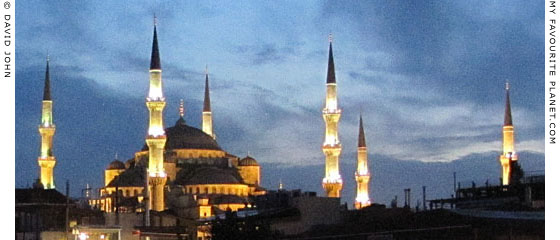
Sultan Ahmed Camii (the Blue Mosque).
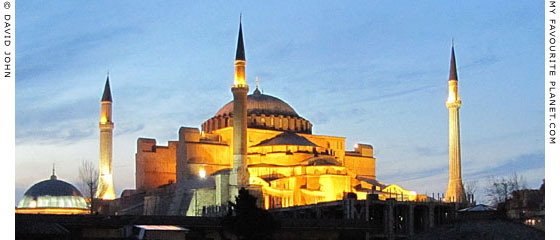
Hagia Sofia (Church of Divine Wisdom).
Ghost writers in the sky. Calligraphic clouds over the Sea of Marmara, Istanbul.
A few snaps taken on the streets of Istanbul.
Put your mouse over an image to see further details.
Topkapi tulips
egg production executive
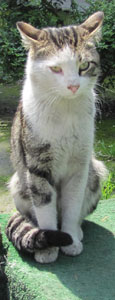
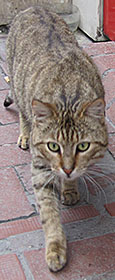
Istanbul cat
Galata Tower
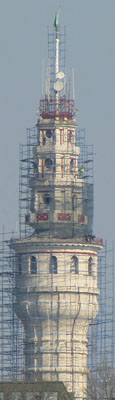
Beyazit Tower
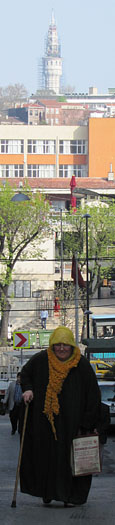
walking up Fatih Hill
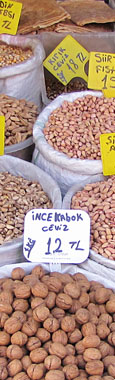
Istanbul nuts
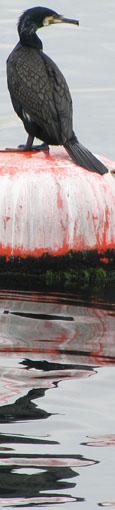
cormorant
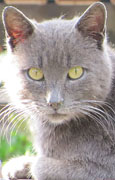
Kumkapi kat
Seraglio cat
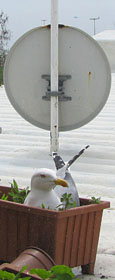
Satellite gull
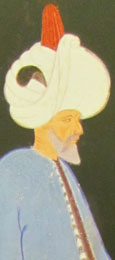
Sultan Süleyman the Magnificent
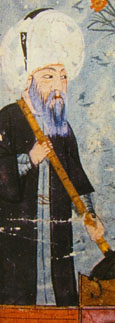
architect Mimar Sinan
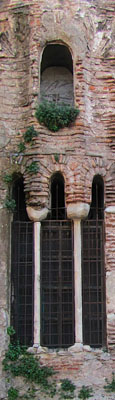
Pantocrator Church window
Blog postscript – Istanbul, the land of cats
During my most recent visit to Istanbul I had the pleasure of meeting Dr. Henrik Hofmann, a vet from Butzbach in Germany, who was visiting the city with his family. Henrik is a man with ideals and an active interest in animal welfare. He runs a blog in German called Es Spricht (It speaks) about his works and interests. The 30 April 2011 edition, "Istanbul ist Katzenland" (Istanbul is the land of cats) www.es-spricht.de/katzen-in-istanbul/, features several of his wonderful photos of cats in Istanbul to accompany his article about the plight of the enormous number of stray animals in the city.
In the blog he also calls for information about animal protection organizations in Turkey. If you can help him, please send a message through his blogsite.
Once again I would like to thank Ilker Erakin at Mavi Onur Guesthouse for his hospitality, help and information. Thanks also to Konstanze Gundudis and Francis Caruso for their cooperation and support, to Hugh Feathertone for making music worth listening to on long bus journeys, and to the people of Istanbul.
Since this blog first appeared the Mavi Onur has closed down, as Ilker is planning to open a new hotel.
The video Istanbul wedding dance can now also be viewed on YouTube. Please feel free to leave a comment on the video's YouTube page and encourage your friends to do so too.
1.Professor Metin And (born 1927, Istanbul; died 2008, Ankara) was one of Turkey's foremost authorities on Turkish theatre, dance, ritual and miniature painting. Many of his books and articles have been translated into English, including:
A History of Theatre and Popular Entertainment in Turkey. Forum Yayınları, Ankara, 1964
Drama at the Crossroads: Turkish Performing Arts link past and present, East and West.
Isis Press. ISBN 978-975-428-026-5
Istanbul in the 16th Century: The City, the Palace, Daily Life. Akbank. ISBN 978-975-7880-03-5
Karagöz: Turkish Shadow Theatre. Dost Yayınları, Istanbul, 1975. ISBN 975-7499-17-6.
I recommend this book, especially for its illustrations (although some of the photos are rather small). It is a valuable source of information about the history of turkish puppet theatre, its cultural environment and origins within the context of other theatre, music and dance traditions, and its influence on puppet theatre in other countries. Available in many bookstores in Turkey and from online sources, from around 30 Turkish Lira (15 Euros).
A Pictorial History of Turkish Dancing. Dost Yayınları, Ankara, 1976.
The careful study of historical documents concerning the origins and cultural milieu of the Köçek (Kochek) dance tradition is a relatively new field, in which Metin And, once again, was a pioneer. Many of the modern works on the subject understandably focus on the gender and sexuality issues surrounding the art form. See, for example:
Prof. Ş. Şehvar Beşiroğlu, Music, Identity, Gender: Çengis, Köçeks, Çöçeks. Musicology Dept., ITU TM State Conservatory. pera-ensemble.com/en/research/134 (also available as illustrated PDF download)
Turkish Cultural Foundation, Court dance in the Ottoman Empire.
"A Question of Köçek – Men in Skirts", at Belly Dancer's Mind – Dance and Transformation, the blog by Aziza Sa’id, a Middle Eastern belly dancer, performer, teacher and coach in Riverside, California.