Well we're on the road to Kavala. There's a thunderstorm and it's raining cats, dogs, zebras, gnus, the lot. We slosh and floosh up hill and down dale, passing farms and villages barely visible through the deluge.
And when we get there in the middle of a gloomy afternoon, the whole town looks closed. There's not a shop light or neon sign on. Boy, these people must take their siesta seriously.
The tourist information is easy to find, and just a short walk from the bus station. Good thing too with all these wet zebras falling out of the sky. The information bureau, a small, single-storey building with windows all round, stands on Platea Eleftherias (Freedom Square). You can't miss it. Apparently it's staffed by volunteers, and very good they are too. We got a map, a brochure about what's on in town and they booked us a room by phone. They even had lights on.
By now it had stopped raining, so we pushed by a herd of bewildered loking gnus and headed out of the modern part of town and uphill through the far cuter old-fashioned Panagia district. The pension was a 17th century house in a narrow street. The owners, an older couple, were very friendly, and our room was - well it was cosy, with a wooden ceiling and a view across the sea to the island of Thassos. I tried the light switch. Nothing. The owner explained there was a power cut due to the storm. That explains that then.
So why are we here? Apart from the chance to see this splendid port town again, we wanted to get to Samothraki. We'd had trouble finding a ferry schedule for the island, even on the internet. The tourist bureau couldn't help us on that score either. I'd asked in a travel agency in Stavros before we began our journey, but even the young professional there drew a blank. He did find the telephone number of the ferry company but we got no answer after several tries.
Nothing for it then, but to hop on a bus to Kavala and get to the port. And here we were standing outside a closed ticket office trying to decipher an ancient timetable taped to the window, when a man appeared and told us there were only two ferries a week to Samothraki: Friday and Sunday. Hmm, today was Tuesday, and despite Kavala's undoubted charms we were determined to get there asap.
The only alternative was to get back on a bus headed for Alexandroupolis. This did not fill me with glee, for that busy modern city is not quite as charming. Grudgingly we walked around the harbour, past some fancy looking cafes and queued for information at the cavernous bus station. While we had been waiting for our bus to Kavala, I had read a timetable which stated that there was a bus to Alex every hour. I naturally assumed that they all stopped in Kavala since it was on the way. But here was a guy telling me there were only two buses a day, 3 am and 9 am. What? Really? He seemed pretty sure. Not only that, but they didn't sell tickets for that destination, we would have to get them at the snack bar across the road. You gotta be joking, right? He was grim in his assertion that he was not.
What was going on here? Didn't Kavalans and Alexandroupolites like each other? Maybe the other buses took the by-pass and thumbed their noses at this damp and darkened town. Perhaps this other bus company, with it's ticket office in a snack bar, had cut its service back. True, there were very few tourists around. We only saw two foreigners the whole time we were in Kavala. (We met them again on the ferry to Samothraki, a Dutch man and an Australian woman. Hi guys, we have the negatives.) The Olympics were going on in Athens, and maybe all the tourists were there or else avoiding Greece altogether because of them.
Kavala and Alexandroupolis are important regional cities with busy bus stations dispatching hundreds of passengers every day from all over Greece and beyond. Duh! I don't get it.
I never did get to the bottom of this anomaly, despite asking around. What I can tell you is this: on our return journey we found out that there is in fact at least one bus an hour between Alexandroupolis to Thessalonika, and they all stop in Kavala. But they don't stop at the bus station. They drive by the bus station and stop 100 metres away. They let passengers off there, but they don't pick any up. If that's not screwy, what is? Some would say that's a very Greek thing. You decide.
Anyway we did eventually get to Alexandroupolis and thence to Samothraki, and very splendid it was too. But that's another story. You can read about that and see some photos in the Samothraki pages.
Meanwhile, back in Kavala the sun had put its hat on. Hip, hip, hip hooray! Suddenly we had real summer afternoon on our hands, ideal for a walkabout. Modern downtown Kavala is fine: seems like a good place to live, send your kids to school, take a stroll in the park, eat a spinach pie, sit under a tree and read a newspaper, talk with your hairdresser about the football game, enjoy some of your neighbour's homemade wine, visit the archaeological museum on Sundays, pick up some forms from the town hall...
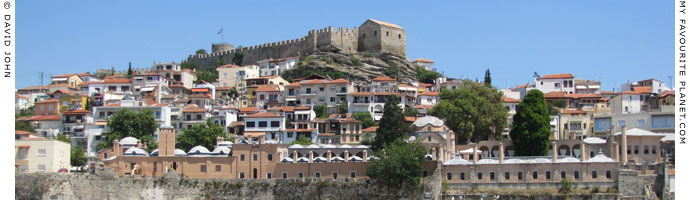
But what makes Kavala worth visiting is the historic Panagia distict, a maze of narrow streets lined with old houses winding up to the Acropolis or Kastro.
David John, August 2004
Postscript
April 2015
Since writing this article some things have changed. Buses between Kavala and Alexandroupoli now leave and depart from the main KTEL inter-city bus stations in their respective cities.
See:
How to get to Kavala
How to get to Alexandroupoli
For a while bus services in the region improved, but the arrival of the Greek economic crisis has meant that schedules for all public transport have been slashed and fares increased. There are still few direct buses between the two cities, and even fewer in winter.
The ferries between Alexandroupoli and
Samothraki still run daily, but there are currently no ferries to the island from Kavala: the very existence of ferry services from Kavala is uncertain. In many cases there is even less reliable information about public transport available now, especially as budgets for running official websites have been cut.