|
|
 |
| My Favourite Planet > English > Europe > United Kingdom > England > Avebury > gallery |
|
| Avebury, Wiltshire |
Avebury gallery |
 |
 |
18 of 67 |
 |
 |
|
|
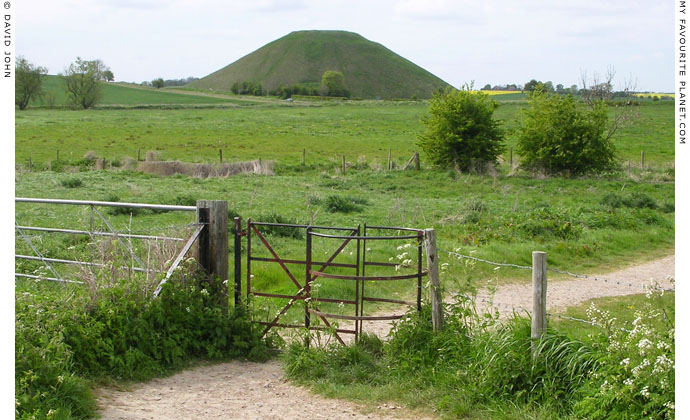
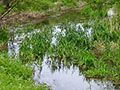
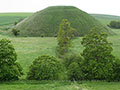
Silbury Hill, West Kennet, viewed from the stile near Swallowhead Springs. |
Let's say you are driving west along the A4 between Marlborough and Chippenham. You've missed the turnoff on your right for the B4003 to Avebury. Rats! That's where you wanted to go. You look for a place to turn around and see there's a lay-by further down the road. Then you notice something else up ahead - something green, something huge. It can't be! Yes it is. It's Silbury Hill.
This enigmatic conical structure is said to be the largest man-made prehistoric mound in Europe [1] at 39.6 metres high, 167 metres in diameter at its circular base, 30 metres across its flat top, covers over 2 hectares and is estimated to consist of 340,000 cubic metres (500,000 tonnes) of local chalk and soil.
So, that's quite huge then. Who works all these things out? someone has even estimated that the construction of Silbury Hill took 4 million man-hours of work.
The first phase of construction has been dated to around 2750 BC, contemporary with the first stone tombs and pyramids in Egypt. Two further building phases resulted in a stepped pyramid of six concentric chalk terraces covered with chalk rubble, flints, gravel and a top layer of soil over which grass grew. The hill was originally surrounded by a ditch.
So why did these Bronze Age folk go to all this effort? Local folklore had it that a certain King Sil was buried there. But three excavations (1776, 1849 and 1967) revealed no tomb, treasure or any other significant contents. The horizontal and vertical shafts dug into the hill have destabilized it, forcing English Heritage to undertake a number emergency repairs since 2002, filling the shafts with chalk and the large hole which had appeared on the top with huge polystyrene blocks.
|
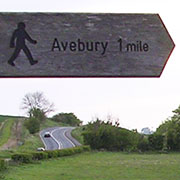
Signpost near Silbury Hill showing the way from the A4 road, over Waden Hill, along West Kennet Avenue to Avebury. |
| |
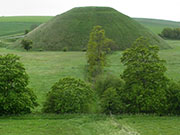
Silbury Hill |
|
Some current archaeological theories are shifting more to the view that prehistoric monuments around Avebury and Stonehenge were primarily burial places. The idea of Silbury Hill as a tomb refuses to go away: if there was no burial in the hill itself, then perhaps it is underneath. Thankfully, it seems unlikely that permission will be granted to excavate beneath the now fragile mound.
Other theories concerning solar observatories, a mother goddess, geomancy, ley lines, etc. remain just that - theories. Keep trying, guys.
In 2007 the reamins of a sizable Roman village were discovered at the foot of Silbury Hill, leading to more speculation about the possible significance of the hill and Swallowhead Springs - sacred or otherwise - into Roman times.
In autumn 1663 King Charles II and his brother the Duke of York (later James II) visited Avebury in the company of the antiquarian John Aubrey (1626 -1697), who had "rediscovered" Avebury in 1649. The royal party is said to have climbed to the top of the hill.
These days, because of its delicate condition, visitors are not allowed on the hill, making it one of the few places around Avebury not directly accessible.
Notes
1. The Motte in Brampton, Cumbria is said to be 42 metres high. However, it is uncertain when it was built. |
|
| |
Articles and photos: © David John, except where otherwise specified.
Many thanks to Mark Mallett, my host and guide in Wiltshire.
Some of the information and photos in this guide to Avebury
first appeared in 2005 on www.davidjohnberlin.de.
All photos and articles are copyright protected.
Images and materials by other authors have been attributed where applicable.
Please do not use these photos or articles without permission.
If you are interested in using any of the photos for your website,
project or publication, please get in contact.
Higher resolution versions are available on request.
My Favourite Planet makes great efforts to provide comprehensive and accurate information
across this website. However, we can take no responsibility for inaccuracies or changes made
by providers of services mentioned on these pages.
We welcome considerate responses to these articles and all other content on My Favourite Planet.
Please get in contact. |
|
 |
Visit the My Favourite Planet Group on Facebook.
Join the group, write a message or comment,
post photos and videos, start a discussion... |
|
|
| |
|
|
| |
| |
 |
| |
 |
| |
 |
| |
 |
| |
 |
| |
 |
| |
George Alvanos
rooms in
Kavala's historic Panagia District
Anthemiou 35,
Kavala, Greece
kavalarooms.gr
|
| |
Papoutsis
Travel Agency
Kastellorizo,
Greece
+30 22460 49 286
papoutsistravel.gr
|
| |
|