|
|
 |
| My Favourite Planet > English > Europe > United Kingdom > England > Avebury > gallery |
|
| Avebury, Wiltshire |
Avebury gallery |
 |
 |
6 of 67 |
 |
 |
|
|
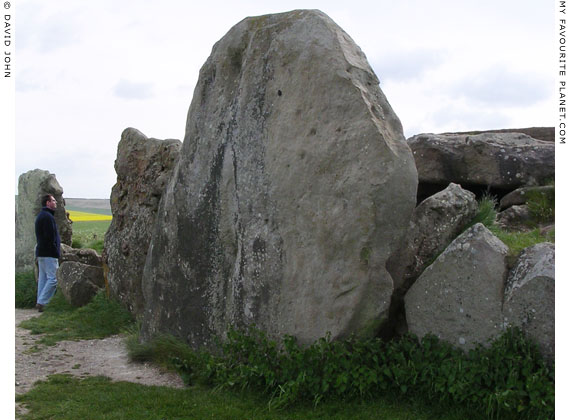
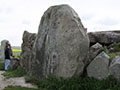
West Kennet Long Barrow. Massive sarsen stone in front of the barrow entrance. |
West Kennet Long Barrow is only 2.4 Km from Avebury and less than a kilometre from Silbury Hill, across the A4 road and along a chalk path. You can hardly see it from the road as it sits low just beyond the top of a grass covered ridge. But you can't miss it: it's signposted, and anyway there's only one path up the hill. On the short walk you cross the River Kennet at Swallowhead Springs, thought to have been sacred in ancient times, then head up the side of the ridge.
Visitors can enter the impressive chambered long barrow and see the huge stones used to build the roof, walls and five separate burial chambers.
A tumulus is a mound of earth covering one or more stone chambers built as a tomb. This form of tomb is extremely ancient and has been found all over Europe and Asia. In Britain, tumuli are known as barrows of which there are two general types: the long barrow and the round barrow.
260 long barrows have been discovered in Britain, with 148 in Wiltshire alone. West Kennet Long Barrow is one of the largest at 104 metres long and 2.4 metres high, although the tomb chambers themselves only take up about 10 metres of the mound's length. It is unknown why the barrows where built so much longer than the graves. It is thought to have been built around 3,600 BC (about 400 years before the first stage of Stonehenge), however, at time of writing the builders were unavailable for interviews to confirm or deny this date.
We're talking about the prehistorical period known as the Neolithic (new stone age) which in Britain lasted from around 4000 BC to 2300 BC. I expect most people were pretty glad when it was over so that they could get on with the Bronze Age.
|
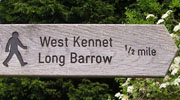
West Kennet Long Barrow
is half a mile from the road. |
| |
 |
|
The length of the barrow lies along a west-east axis, aligned with the spring equinox. The mound was built from chalk and earth dug from trenches either side of and parallel to it, which nature has filled over the millenia. The entrance is at the eastern end, guarded by a row of "sarsen" stones (large sandstone monoliths), standing on a north-south axis, the largest of which is over 3 metres tall and stands directly in front of the tomb's entrance (gallery pages 6 and 7). Apparently, these stones were repositioned in 1956.
Between the largest monolith and the low stone-linteled grave doorway is a "forecourt" of about 1.5 metres width (gallery pages 8 and 9). Once through the door, you find yourself in a passage, high enough for a person of average height to stand upright in. There are two small burial chambers on each side of the passage and a larger fifth, 2.3 metres high, at its end (gallery pages 10-17). Surprisingly, it does not smell - even of damp - inside the barrow.
The outer walls of the tomb and those separating the chambers are built of large upright stones with horizontal rows of various sized stones laid between and above them, supporting huge slab ceilings. The larger stones and boulders come from the downs nearby, while the smaller stones were brought from a location over 50 Km away.
Excavations in 1859 and 1955-56 discovered the remains of about 50 people of all ages, several pottery sherds, flint implements, beads and other objects. The burials took place over a considerable period of time.
At some point between 2500 and 2200 BC the tomb was sealed up with chalk and rubble and the entrance blocked by the sarsens.
As with all the other sites around Avebury, the chronology of the long barrow, the methods used for its construction, the nature of its use, the customs, traditions, rituals and very identity of the people who built and used it are unknown. A mystery wrapped in an enigma. This leaves a lot of room for speculation, theories and downright nonsense. Great. It all makes life so much more interesting.
Whatever the truth, this is a remarkable and beautiful place within a spectacular and intriguing area. Thanks to the British Department of the Environment, the National Trust (which manages the site), and the people of Wiltshire. |
|
| |
Articles and photos: © David John, except where otherwise specified.
Many thanks to Mark Mallett, my host and guide in Wiltshire.
Some of the information and photos in this guide to Avebury
first appeared in 2005 on www.davidjohnberlin.de.
All photos and articles are copyright protected.
Images and materials by other authors have been attributed where applicable.
Please do not use these photos or articles without permission.
If you are interested in using any of the photos for your website,
project or publication, please get in contact.
Higher resolution versions are available on request.
My Favourite Planet makes great efforts to provide comprehensive and accurate information
across this website. However, we can take no responsibility for inaccuracies or changes made
by providers of services mentioned on these pages.
We welcome considerate responses to these articles and all other content on My Favourite Planet.
Please get in contact. |
|
 |
Visit the My Favourite Planet Group on Facebook.
Join the group, write a message or comment,
post photos and videos, start a discussion... |
|
|
| |
|
|
| |
| |
 |
| |
 |
| |
 |
| |
 |
| |
 |
| |
 |
| |
George Alvanos
rooms in
Kavala's historic Panagia District
Anthemiou 35,
Kavala, Greece
kavalarooms.gr
|
| |
Papoutsis
Travel Agency
Kastellorizo,
Greece
+30 22460 49 286
papoutsistravel.gr
|
| |
|