|
|
|
| My Favourite Planet > English > Europe > Greece > Attica > Athens > galleries > Acropolis |
|
| |
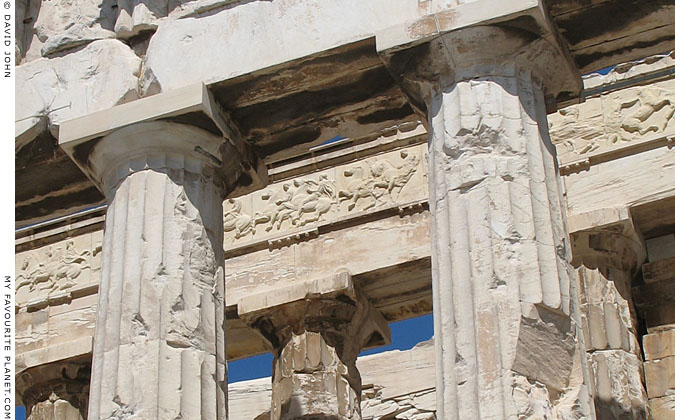
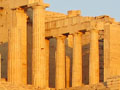
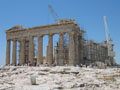
The west side of the Parthenon |
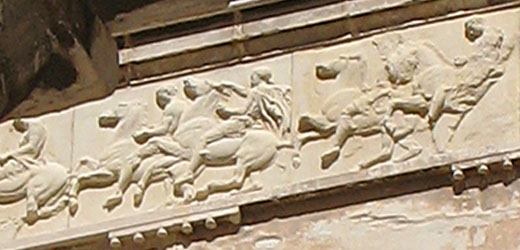
Detail of the frieze of the Parthenon west side.
|
The Parthenon frieze representing the Great Panathenaic Procession consisted of 115 irregularly-sized panels, made up of 111 marble blocks (each corner block having a panel on adjacent sides): the north and south sides each had 47 panels, the west side 14 and the east side 7.
The system used for numbering the panels was originated by Adolf Michaelis in 1871 (published in his book Der Parthenon). He used Roman numerals for the panels and Arabic numerals for the figures depicted on them. The numbering system is not perfect, as at the time Michaelis made his drawings many of the panels were missing; some had been removed during the early Christian era to make way for windows along the north and south sides (three on each side). One fragment even found its way to Sicily (see photo below), and new fragments are still being discovered [1].
See a plan of the general scheme of the friezes below. |
|
| |
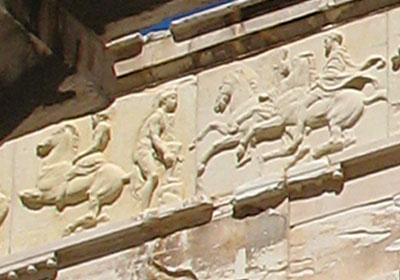
Detail of the frieze of the Parthenon west side. |
|
| |
| |
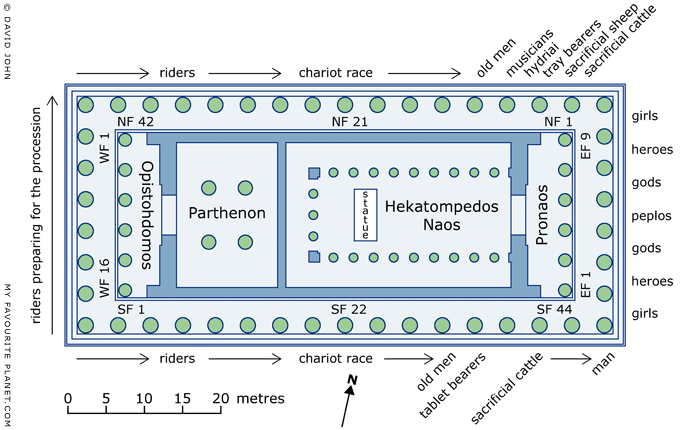
Plan of the Parthenon showing the general scheme of the friezes. |
| |
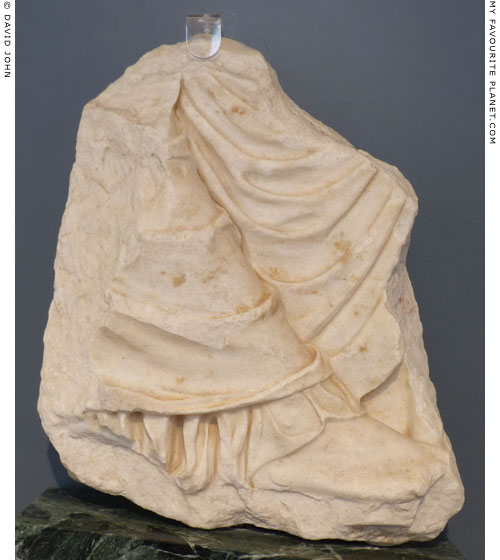
A Fragment of the east side of the 160 meter long frieze around
the outside of the Parthenon cella, now in Palermo, Sicily.
Antonino Salinas Regional Archaeological Museum, Palermo, Sicily.
From the Fagan Collection.
|
The fragment shows the draped lower right leg and bare foot of Artemis, who in the section of the frieze was seated between Apollo and Aphrodite. It is known to have been on slab VI of the frieze from drawings of the 17th century (Carrey, 1674), but was already missing from the plaster reproductions made by Louis François Sébastien Fauvel in 1787. The only other known surviving fragment of the slab is in the Acropolis Museum.
It is not known how or when the fragment was acquired by Robert Fagan (1761-1816), a London-born Irish painter and archaeologist who carried out excavations at the Via Appia, Ostia and Lazio near Rome 1784-1807. He was befriended with Queen Maria Carolina who appointed him Consul General of Sicily and its adjacant islands, and he excavated at Piazza Amerina, Palazzolo, Taormina and Tyndaris. He managed to acquire a large private collection of antiquities from Greece and Sicily. However, he fell out of favour and was accused of unscrupulous conduct. Due to financial problems he lost his collection and other assets, and left for Rome where he committed suicide. Several objects from his collection are now in the Palermo museum. [2] |
|
|
| |
| The Parthenon |
Notes, references and links |
 |
|
1. Christopher Hitchens, Robert Browning, Graham Binns, The Elgin marbles: should they be returned to Greece?. Verso, 1998.
2. The Fagan Collection
Some other ancient artifacts from the Fagan Collection:
An Athenian proxeny decree for Sochares of Apollonia, Thrace.
A statue Agrippina the Elder from Tyndaris, Sicily. |
|
|
Photos, illustrations, maps and articles: © David John,
except where otherwise specified.
Additional photos: © Konstanze Gundudis
All photos and articles are copyright protected.
Images and materials by other authors
have been attributed where applicable.
Please do not use these photos or articles without permission.
If you are interested in using any of the photos for your website,
project or publication, please get in contact.
Higher resolution versions are available on request.
My Favourite Planet makes great efforts to provide comprehensive and accurate information across this website. However, we can take no responsibility for inaccuracies or changes made by providers of services mentioned on these pages. |
|
| |
 |
Visit the My Favourite Planet Group on Facebook.
Join the group, write a message or comment,
post photos and videos, start a discussion... |
|
|
|
| |
|
|
| |
| |
 |
| |
 |
| |
 |
| |
 |
| |
 |
| |
 |
| |
George Alvanos
rooms in
Kavala's historic Panagia District
Anthemiou 35,
Kavala, Greece
kavalarooms.gr
|
| |
Papoutsis
Travel Agency
Kastellorizo,
Greece
+30 22460 49 286
papoutsistravel.gr
|
| |
|