Athens
Acropolis |
Practical information |
|
 |
|
Ticket prices and opening times are subject to change.
The following information was last researched and updated on 30 July 2022. |
| |
Acropolis, Athens
Tel: +30 210 321 41 72
Fax: +30 210 923 90 23
Email: efaath@culture.gr
Website: odysseus.culture.gr/h/3/eh355.jsp?obj_id=2384
Getting there
The Acropolis is in the centre of Athens, around 1 kilometre southwest of Syntagma Square, and immediately south of the Plaka district.
A number of buses, trolley buses and trams stop on Amalias Avenue (Leoforos Vas. Amalias, which starts at the top of Syntagma Square), just opposite the Temple of Olympian Zeus and the National Gardens, near the start (east end) of Dionysiou Areopagitou Street (Οδός Διονυσίου Αρεοπαγίτου), which is a pedestrianized zone.
The ACROPOLIS metro station, also near the start of Dionysiou Areopagitou Street, is around 300 metres east of the main entrance.
The Acropolis Museum (separate ticket, see note 1 below) is on the south side of Dionysiou Areopagitou Street, on the right as you walk from the metro station to the Acropolis main entrance.
Entrances
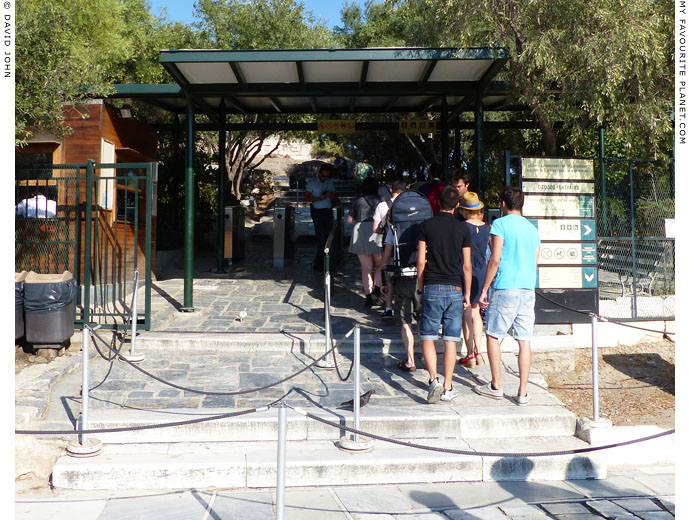
Main entrance
For those with less time or only wishing to visit the monuments on the top of the Acropolis (the citadel), such as the Parthenon, the main entrance is the most direct route.
The main entrance and ticket office, are at the west side of the Acropolis, uphill along a footpath leading from the north of Dionysiou Areopagitou Street (pedestrianized), on the right if you are coming from the metro station and city centre. The way is well signposted, and usually you just have to follow the crowds.
Near this entrance are toilets, a museum shop and a post office. Snacks and drinks are also on sale.
Once you have entered the site, it is a steep walk up to the citadel with plenty of stairs.
The North Slope of the Acropolis
To visit the sanctuaries and caves below the North Slope of the Acropolis, use the main entrance and ask for directions to Caves of Pan and Apollo.
From there the Peripatos, the footpath right around the foot of the rock, leads eastwards along the north side and then around to the south side, the Theatre of Dionysos and the entrance/exit of the South Slope.
The South Slope of the Acropolis
There is a separate entrance for the archaeological site of the South Slope of the Acropolis, which includes the Theatre of Dionysos and the Temple of Asklepios.
This is below the southeast end of the Acropolis, nearer to the metro station, on the corner of Dionysiou Areopagitou Street and Thrasyllos street (Οδός Θρασύλλου, Odos Thrasyllou), just past the tourist information office.
There are toilets inside the entrance as well as a vending machine for soft drinks.
After visiting the area around the theatre, you can follow the Peripatos footpath either westwards, up past the Temple of Asklepios and then to the top of the Acropolis, or eastwards from above the theatre around to the north side of the Acropolis and then on to the main entrance.
The Odeion of Herodes Atticus
The Odeion of Herodes Atticus is not usually open to the public, but its facade can be viewed from a piazza, accessible by steps from the north side of Dionysiou Areopagitou Street, on the right if you are coming from the city cente, about 100 metres before the footpath to the main entrance. A footpath from this piazza also leads to the main entrance.
The odeion is used for concerts and other performances during the summer, and tickets can be purchased from ticket agencies, and sometimes from a booth in front of the odeion. |
|
The Acropolis Museum has different opening times
and requires a separate ticket [See note 1 below].
Opening hours
Daily 8:00 - 20:00
Last admission 19:30
Holidays
Closed on the following days:
1 January
25 March
1 May
Easter Sunday
25 and 26 December
Tickets
Tickets for the Acropolis and other state-owned archaeological sites and museums in Athens can be purchased at the entrance to the respective site.
You can now also buy tickets online: www.etickets.tap.gr.
Tickets are valid for the citadel and North and South slopes.
Summer (1 April - 31 October): Full €20, Reduced €10
Winter (1 November - 31 March): Full €10, Reduced €5
(All state-owned archaeological sites in Athens are half-price in winter.)
For a list of those eligible for reductions and free admission,
see the Odysseus website of the Ministry of Culture.
"Unified ticket"
All year round: Full €30, Reduced €15
Valid for 5 days
This combined or "Unified ticket" (also referred to as a "Special ticket package") allows entrance to all the following archaeological sites and museums in Athens:
• the Acropolis (including the North and South slopes),
• the Ancient Agora Archaeological Site and Museum,
• the Roman Agora,
• Hadrian's Library,
• the Kerameikos Archaeological Site and Museum,
• the Olympieion,
• the Lykeion Archaeological Site ("Aristotle's Lyceum")
Combined tickets are NOT valid for the Acropolis Museum or any other museum not listed here.
The ticket is stamped each time you visit one of these sites. Admission to each site is allowed only once per ticket.
You can save money with this ticket if you plan to visit the Acropolis and two other sites within 5 days in summer. In winter, all the sites are half price, but the combined ticket still costs the same, so you may not make savings
If you want to calculate possible savings, see the ticket prices and opening times for the individual sites in note 1 below.
TIP: There are often long queues for tickets at the Acropolis, so buy your combined ticket at one of the other sites where there is less waiting time.
Free admission days
(for everyone)
6 March (in memory of Melina Mercouri)
18 April (International Monuments Day)
18 May (International Museums Day)
The last weekend of September (European Heritage Days)
28 October
Every first Sunday of the month, 1 November - 31 March
For information about free and reduced admission to Greek state archaeological sites, monuments and museums, read the PDF document issued by the Greek government:
culture.gov.gr/DocLib/Admission_Info_140721.pdf |
|
|
| |
Amenities for disabled people
An elevator up to the top level of the Acropolis is available for wheelchairs, physically challenged people and any parent attending two or more infants on her/his own.
The elevator is located on the north side of the Acropolis, about 350 metres from the main entrance of the archaeological site (see gallery page 5).
Contact in advance for details and terms: +30 210 321 41 72
The elevator is not available during extreme weather conditions and strong winds.
The ground on the citadel of the Acropolis is very uneven, and in places the bare rock is very slippery. The only steps are down to the toilets (there is also a ramp), and to the rear of the Erechtheion, although there is also an inclined path to this side of the monument.
Other facilities
There are toilets on the top of the Acropolis, accessible by steps and a ramp. They are at the southeast end, on the right just behind the Parthenon (the location of the Old Acropolis Museum). There is also a fresh water fountain near the toilets.
Several members of staff are usually around the site if you need help or directions.
There are several cafes, restaurants peripteros (kiosks) and shops in the streets around the Acropolis (mostly at the southeastern end towards the city centre), and even more in the nearby Plaka distict. Many are expensive - tourist prices apply. |
|
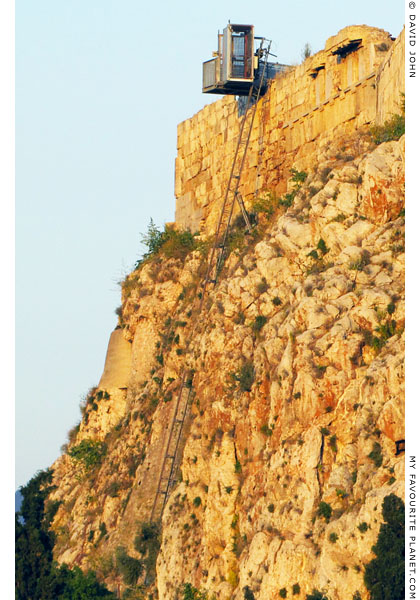
The elevator up to the top level of the Acropolis for
wheelchairs, physically challenged people and any
parent attending two or more infants on her/his own. |
|
| |
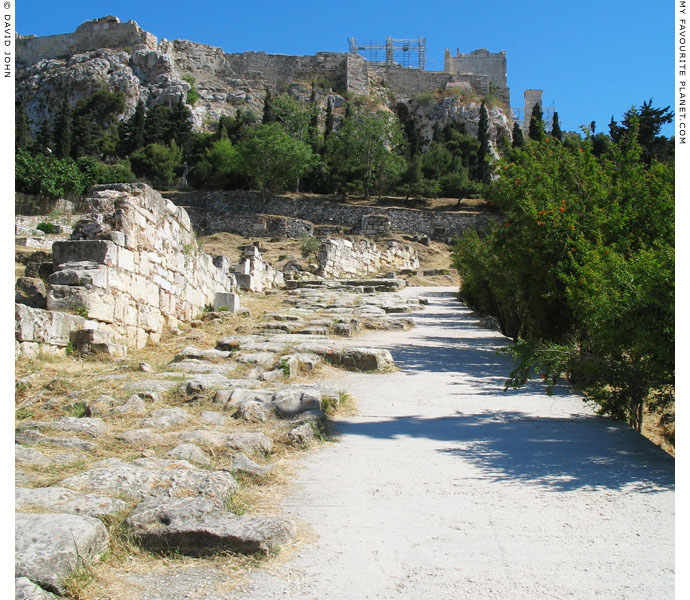
The section of the Sacred Way from the Agora up to the northeast side of the Acropolis.
The Sacred Way, the route of the Panthenaic procession, led from the city gate at Kerameikos, through the Agora, then uphill to the main entrance of the Acropolis on its west side (see above). This straight, steep section starts immediately south of the entrance to the Agora archaeological site and continues for a few hundred metres. The path is of modern concrete but some of the ancient paving stones can be seen on the left. To either side are remains of ancient and Byzantine walls and buildings and a few steles with inscriptions.
Along the east side (left in this photo) of this stretch of the Sacred Way ran the sanctuary wall of the City Eleusinion (Ελευσίνιον), which contained a temple of Demeter and Persephone and a temple of Triptolemos (see Demeter and Persephone).
The way then continues as a winding footpath - including flights of steps - beneath pine trees, to a narrow road. Then turn right (eastwards) up to the Areopagus Hill and the Acropolis, or left (westwards) down to the Plaka.
This area is fenced off and gated, but at present admission is still free, and it remains a sort of park with ruins. It is a pleasant place to walk, particularly if you have more time in Athens and would like to spend some of it in areas with no traffic. Although it was once part of the centre of classical Athens, the ruins here are neither remarkable nor distinct, and are of interest mainly to those keen to learn more about the city's ancient history. |
|
| |
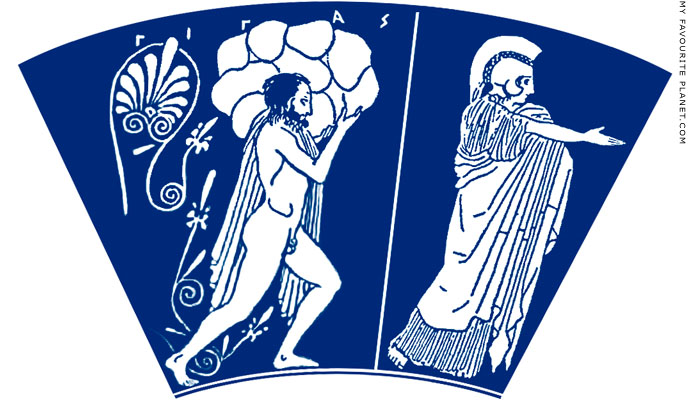
Athena directs a giant, identified by the inscription Γιγας
(Gigas, Giant), who carries a large rock on his left shoulder,
for the construction of the "Pelasgic walls" of the Acropolis.
Drawing of the painting on the front of an Attic red-figure skyphos
(two-handled deep drinking cup), attributed to the Penelope Painter,
around 440-430 BC. From Nola, Campania, southern Italy.
Height 19.9 cm, diameter 23.1 cm, width 33.7 cm.
Louvre, Paris. Inv. No. G 372.
From the Campana Collection. Acquired in 1863.
The vertical line between the two figures is thought to represent Athena's spear, planted in the ground, symbolizing the goddess, who is not wearing an aegis, as Athena Ergane (the Worker), engaged in the peaceful rather than warlike activity of the building of Athens. The spear may be acting as a marker or measuring rod.
On the other side of the skyphos is a depiction of two draped men, perhaps a building supervisor (επισκοπος) and an architect, standing either side of a tree without foliage. One is named Φιλυας (or Φιγυας, Phylias or Phygias), the other holds what is thought to be a staphyle (σταφυλὴν, literally a bunch of grapes), a measuring line weighted with knobs of lead which resembled a cluster of grapes.
The prehistoric circuit wall around the top of the Acropolis, built of large uncut grey-blue limestone, is referred to as Mycenaean, Cyclopean and Pelasgic (or Pelasgian), also known as the Pelargikon or the Enneapylon (nine-gated). Built around the end of the 13th century BC (Late Helladic IIIB), some time after the walls of Mycenae and Tyrins, it surrounded the entire citadel, enclosing an area of 25,000 square metres, and was around 760 metres long, up to 10 metres high and 3.5 - 6 metres thick. It continued to serve as the main defensive structure on the Acropolis for 800 years, until the construction of new defences in the 5th century BC, particularly the Themistoklean Wall (built 478 BC), following the Persian invasion of 480-479 BC. Remnants of the wall have survived, including a short stretch to the south of the Propylaia (see the plans of the Propylaia on gallery page 10).
From at least the Classical period the wall was believed to have been built by the Pelasgians, the name given to the native peoples who lived in Greece before the arrival of the Greeks. Because of the large size of the rocks used to build such walls in prehistoric times, legends grew that the builders were giants (Γίγαντες, Gigantes; singular, Γίγας, Gigas) or the Cyclopes (Κύκλωπες, Kyklopes), the mythical race of giants (see Homer part 3), hence the name "Cyclopean walls".
Image source: Martin Luther D'Ooge, The Acropolis of Athens. Macmillan, New York, 1909.
Originally published in: Friedrich Hauser, Der Bau der Akropolismauer: Ein Vasenbild, in Walther Amelung and others, Strena Helbigiana, pages 115-121. B.G. Teubner, Leipzig, 1887. At the Internet Archive. |
|
| |
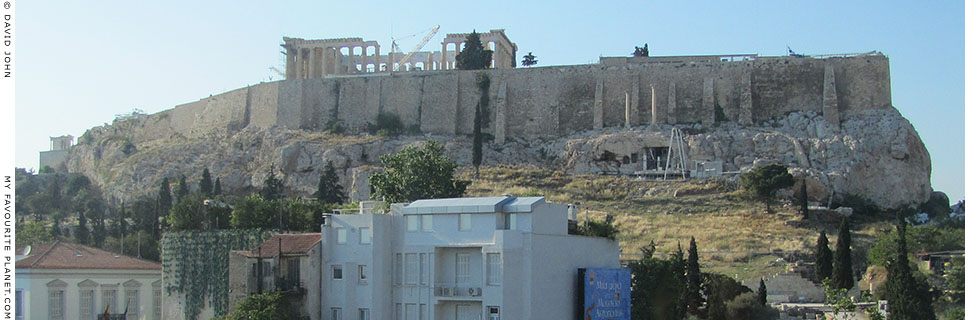
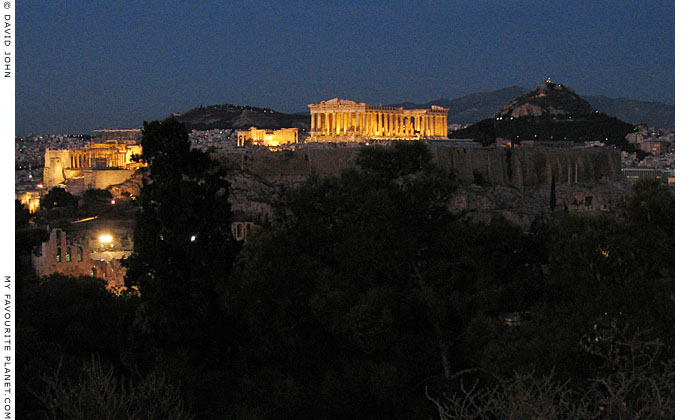
The south side of the Acropolis, as seen from the New Acropolis Museum. |
| |
Mount Pendeli |
Mount Lykavittos |
The Acropolis: Propylaia, Frankish Tower and Parthenon |
Mount Hymettos (Ymettos) |
|
 |
|
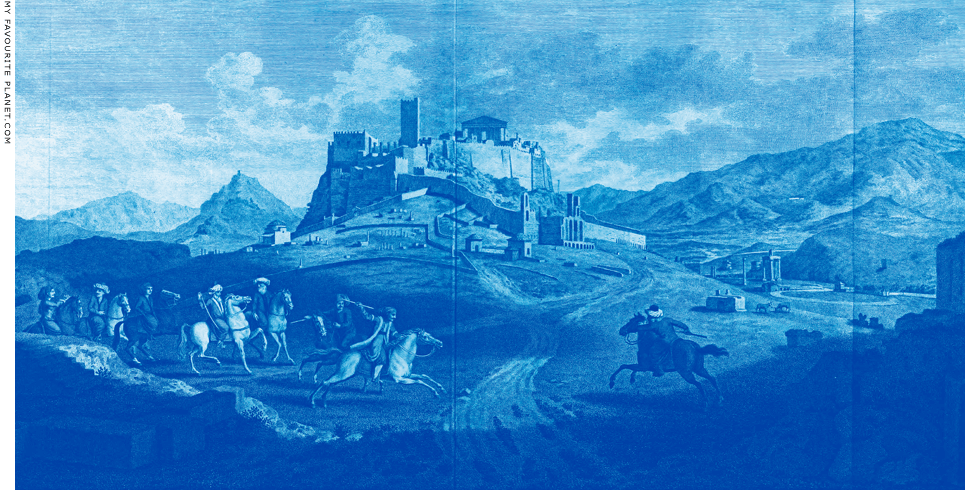
View of the Acropolis from the west, drawn by James "Athenian" Stuart,
during his stay in Athens with Nicholas Revett 1751-1753.
Stuart describes the scene:
"A View of the Acropolis, taken from the situation of the ancient Piraic Gate...
The stones on the foreground are ruins of the ancient city walls.
The figures represent some of the principal Turkish inhabitants, diverting themselves at their favorite exercise, the jereet. On the right hand is the Disdar Aga, at whom the Vaiwode is about to throw his jereet, and rescue his Kaiyah from the Disdar, who pursues him. The next is the Mudereese Effendi, who is conversing with Achmet Aga, the richest and most respectable Turkish gentleman of Athens. The other Figures represent their attendants."
The Vaiwode (or Voivode) was the Turkish governor of Athens. The Disdar Aga was the military commander who lived in the Medieval palace in the Propylaia and kept his harem in the Erechtheion.
See more about Stuart and Revett on Acropolis gallery page 12.
See a painting of the same view by William Page nearly a century later on Acropolis gallery page 32.
Source: James Stuart and Nicholas Revett, The Antiquities of Athens, measured and delineated, Volume II, Plate I. Printed by John Nichols, London, 1787. At the Internet Archive. |
|
| |
Athens
Acropolis |
Notes, references and links |
|
|
1. Ticket prices and opening times for other archaeological sites and museums in Athens
Ticket prices and opening times are changing constantly, and the official websites of the Greek
Ministry of Culture and individual museums do not always provide the latest information.
Last admission is usually 30-45 minutes before closing.
"Unified ticket" sites and museums
Prices are shown full /reduced. Tickets are 50% cheaper 1 November - 31 March.
• Acropolis Archaeological Site (including North and South slopes), €20 / €10. Open 8:00 - 20:00.
• Ancient Agora Archaeological Site and Museum, €10 / €5. Open 8:00 - 20:00.
• Roman Agora, €6 / €3. Open 8:00 - 15:00; weekends 8:00 - 17:00.
The site includes the Tower of the Winds and the recently restored Fethiye Mosque.
• Hadrian's Library, €4 / €2. Open 8:00 - 15:00 (closes 3 pm!).
• Kerameikos Archaeological Site and Museum, €8 / €4. Open 8:00 - 20:00.
• Olympieion, €6 / €3. Open 8.00 - 20.00.
Some parts of this large site are not always accessible, depending on staffing.
• Lykeion Archaeological Site ("Aristotle's Lyceum"), €4 / €2. Open 8:00 - 20:00.
Other state archaeological museums in Athens
The sites and museums below are NOT included in the "Unified ticket" package.
• Acropolis Museum
Summer (April - October): Full €10, Reduced €5
Winter (November - March): Full €5, Reduced €3
The new museum was previously open regular hours, 7 days a week.
Now the times are more complicated.
Summer (1 April - 31 October): Monday 8:00 - 16:00;
Tuesday - Sunday: 8:00 - 20:00; Friday 8:00 - 22:00.
Winter (1 November - 31 March): Monday - Thursday 9:00 - 17:00; Friday 9:00 - 22:00;
Saturday - Sunday 9:00-20:00.
website: www.theacropolismuseum.gr/en/plan-your-visit
• The Panathenaic Stadium, Pangrati, Athens
Tickets (from 1 January 2022): €10; reductions (students & visitors over 65 year old) €5.
Free Admission: children under 6 years; visitors with disabilities & person accompanying them.
Opening hours:
March - October 8:00 - 19:00;
November - February 8:00 - 17:00.
Website: www.panathenaicstadium.gr
The stadium, run by the Hellenic Olympic Committee, is a historical rather than an archaeological site.
A modern reconstruction of the Roman stadium, it contains ancient statues and a small museum.
Until March 2017 there was a different "Unified ticket" package for the following four museums
(€15 / €8, valid for 3 days), but this appears to be no longer available.
Ask at the respective museum for current deals.
• National Archaeological Museum, €10.
Prices and times have recently changed.
Opening hours 1st April - 31st October 2018:
Monday 13:00 – 20:00; Tuesday - Sunday 8:00 - 20:00
Website: namuseum.gr/visiting/index-en.html
• Byzantine and Christian Museum, €8 / €4.
"1st November - 31st March there is no reduction. Special ticket package is excluded."
Summer: Tuesday - Sunday 8:00 - 20:00; Monday 12:00 - 20:00.
Winter (1 November - 31 March): Tuesday-Sunday 09:00 - 16:00; Monday closed.
Website: byzantinemuseum.gr/en/
• Numismatic Museum, €6 / €3. Open Tuesday - Sunday 8:30 - 15:30; Monday closed.
Website: nummus.gr/ht/exb_1stf1_en.htm<
• Epigraphic Museum, €2. Open Tuesday - Sunday 8:00 - 15:00; Monday closed.
State archaeological sites and museums near Athens
• Brauron Archaeological Site and Museum, €6 / €3. Open 8:00 - 15:00; Monday closed.
• Eleusis Archaeological Site and Museum, €6 / €3. Summer 8.00 - 20.00; Winter 8.00 - 15.00.
• Laurion Archaeological Museum, €2 / €1. Open 8:00 - 15:00; Monday closed.
• Marathon Archaeological Museum, €6 / €3. Open 8:00 - 15:00; Monday closed.
• Megara Archaeological Museum, €2 / €1. Open 8.00 - 15.00; Monday closed.
• Piraeus Archaeological Museum, €4 / €2. Open 8:00 - 15:00; Monday closed.
• Sounion Archaeological Site, €8 / €4. Summer 9:00 - sunset; Winter 9:30 - sunset.
• Thorikos Archaeological Site, free admission. Daily access to the site is free. |
|
|
Photos, illustrations, maps and articles: © David John,
except where otherwise specified.
Additional photos: © Konstanze Gundudis
All photos and articles are copyright protected.
Images and materials by other authors
have been attributed where applicable.
Please do not use these photos or articles without permission.
If you are interested in using any of the photos for your website,
project or publication, please get in contact.
Higher resolution versions are available on request.
My Favourite Planet makes great efforts to provide comprehensive and accurate information across this website. However, we can take no responsibility for inaccuracies or changes made by providers of services mentioned on these pages. |
|
| |
 |
Visit the My Favourite Planet Group on Facebook.
Join the group, write a message or comment,
post photos and videos, start a discussion... |
|
|
| |
| Copyright © 2003-2025 My Favourite Planet | contents | contributors | impressum | sitemap |
| |