|
|
|
| My Favourite Planet > English > Europe > Greece > Attica > Athens > galleries > Acropolis |
|
| |
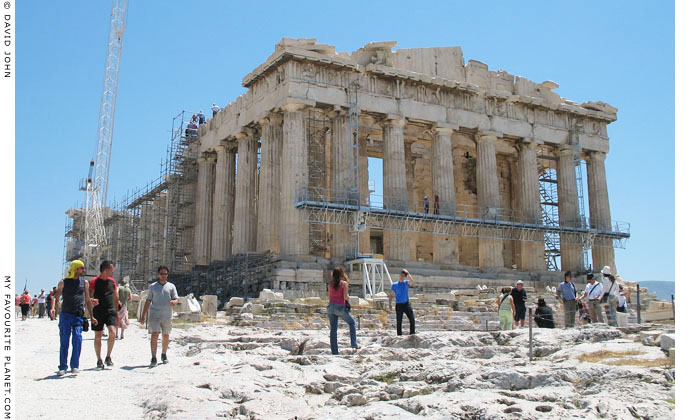
The first view visitors get of the Parthenon after climbing up to the Acropolis. |
| The Parthenon |
| |
"Oh You, gleaming and violet-crowned glorious Athens,
famous in songs, bulwark of Hellas, city divine!"
Pindar (Πίνδαρος, circa 522-443 BC), Fragments, 76.
If the Acropolis was the voilet crown of Athens, then the Parthenon (Παρθενών), which stands on the highest point on the rock, was to become the jewel in the crown, although the Theban poet Pindar did not live to see it completed. It is the largest and finest building ever built on the Acropolis, the most important surviving Classical building in Greece, one of the most famous buildings in the world, and the main reason most visitors come to Athens.
The Doric temple was dedicated to Athena, the city's patron goddess, and its main chamber at the east end contained a colossal statue of her, known as the Athena Parthenos (Ἀθηνᾶ Παρθένος, Athena the Virgin, see below), made of gold and ivory by the sculptor Pheidias. The second room, on the west side, was used as a treasury. It was built between 447 and 438 BC, when Classical Athens was at the zenith of its political and financial power as head of the Delian League (see History of Stageira part 5), which was effectively an Athenian empire, and at what is considered the height of Greek Classical art.
"The temple of Minerva Parthenos is on the right after passing the propylaea, and is, without exception, the most magnificent ruin in the world, both for execution and design. Though an entire museum has been transported to England from the spoils of this temple, it remains without rival."
Sir William Gell (1777-1836), English archaeologist and illustrator [1]
"Let him who denies the sublimity of Grecian architecture travel to Athens, view the ruins of the Parthenon, and be silent."
Peter Edmund Laurent, (1796-1837), English classical scholar [2] |
|
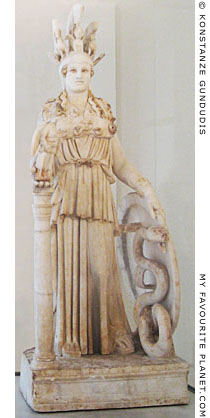
"The Varvakeion statuette"
of Athena Parthenos. Copy
of the statue by Pheidias.
National Archaeological
Museum, Athens.
See details below. |
|
| |
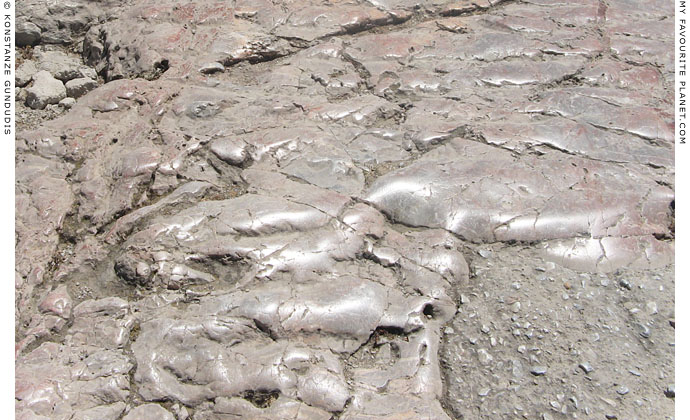
CAUTION: SLIPPERY SURFACE!
The steeply sloping ground between the Propylaea entrance
to the Acropolis and the Parthenon consists of slippery and
uneven stone. Watch your step, especially if it has been raining. |
| |
Two other large temples are thought to have previously stood on this part of the Acropolis, the identification, location and history of which are still being debated. The first may have been the temple referred to by ancient authors as the Hekatompedon (ἑκατόμπεδος, Hekatompedos, hundred-footer), although the length of the building may not have been exactly 100 Attic feet (32.8 metres). It has been also referred to by modern historians as the "Parthenon 1", "UrParthenon" (Primal Parthenon), "Bluebeard temple" or, less romantically, "Building H".
It is thought to have been built of limestone around 570-550 BC (later according to some theories), and has been associated with the establishment of the Great Panathenaia festival in 566/565 BC, during the archonship of the aristocrat Hippokleides. Several sculptures believed to be from this temple are now in the Acropolis Museum (see below).
The German archaeologist Wilhelm Dörpfeld believed that the foundations to the south of the Erechtheion belong to the Hekatompedon (see the site marked "Early temple of Athena" on the plan of the Acropolis on gallery page 2 and the photo at the top of gallery page 18), although the prevailing theory is that they belong to the Archaic Temple of Athena Polias which was later replaced by the Erechtheion.
The first temple was replaced by a larger temple, named the "Pre-Parthenon" or "Parthenon 2" by archaeologists. It stood on the same spot as the Parthenon, and part of its foundations can still be seen beneath the south side of the Classical temple. Construction was begun shortly after the Battle of Marathon (490 BC), but had not been completed by the time of the Persian invasion of Xerxes in 480-479 BC, when the buildings on the Acropolis were burnt down (see the model of the Acropolis as it may have appeared in 480 BC on gallery page 2).
After the Persians had been defeated at the Battle of Salamis (480 BC) and the Battle of Plataea (479 BC), and finally driven out of Greece, the Athenians vowed not to rebuild the destroyed buildings on the Acropolis. The city economy recovered and grew, partly due to sources of revenue such as the silver mines at Lavrion in southern Attica, as well as the tribute money Athens received as leader of the Delian League from other Greek member states. In 454 BC the Athenians transferred the treasury of the league from Delos to Athens.
The statesman Pericles (Περικλῆς, circa 495-429 BC), the most influential politician in democratic Athens around 461-429 BC, persuaded the Athenians to use a great deal of their new wealth for an ambitious building programme on the Acropolis, including the construction of the Erechtheion, the Propylaia, the Temple of Athena Nike and the Parthenon, as well as a large number of statues and other sculptures.
The sculptor Pheidias, a close friend and political ally of Pericles, was put in overall charge of the building project, and Iktinos and Kallikrates were chosen as the architects of the Parthenon [3]. Pheidias and his pupils, as well as a number of other artists, stonemasons and craftsmen were responsible for carving, constructing and painting the architectural members, sculptures and reliefs of the temple. Although the building itself was finished by 438 BC, work on the sculptures and other decoration continued until the outbreak of the Peloponnesian War with Sparta (431-404 BC), which strained Athens' resources and led to its ruin and the end of the brief period of cultural brilliance. |
|
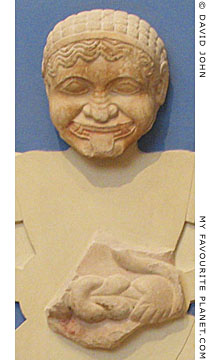
Fragments of an Archaic
marble statue of the Gorgon
Medusa, thought to be an
akroterion (roof decoration)
from the Hekatompedon,
the "UrParthenon" Athena
temple, built around
575-550 BC.
Acropolis Museum, Athens.
Inv. Nos. Acr. 701 (head)
and Acr. 3798 (belt).
See further details on
the Medusa page of the
MFP People section. |
|
| |
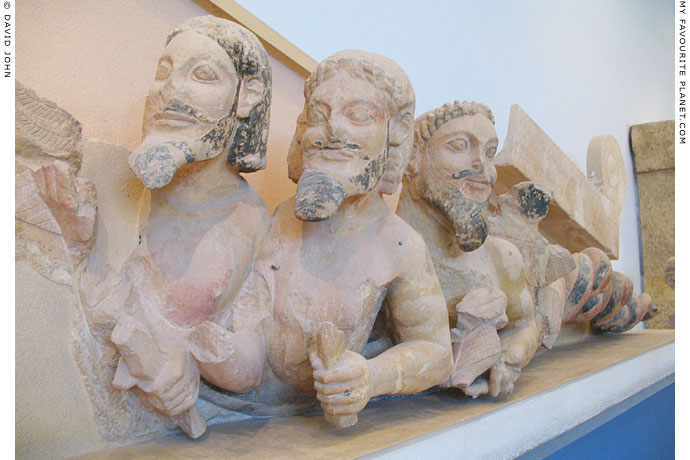
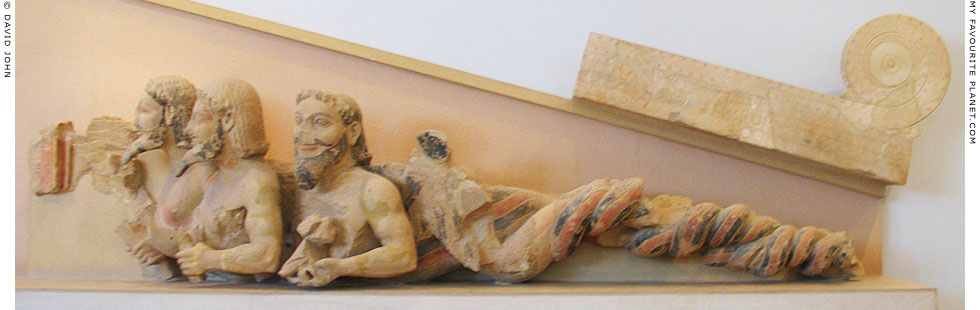
Poros (limestone) relief of the "Three-bodied Daemon", thought to be from the west
pediment of the Archaic "UrParthenon" temple of Athena, known as the Hekatompedon.
Mid - late 6th century BC. Reconstructed from fragments found in 1888 to
the east and southeast of the Parthenon. Height 77.5 cm, length 325 cm.
Acropolis Museum, Athens. Inv. No. 35.
See the reconstruction of the right side of the pediment,
as exhibited in the Old Acropolis Museum below. |
| |
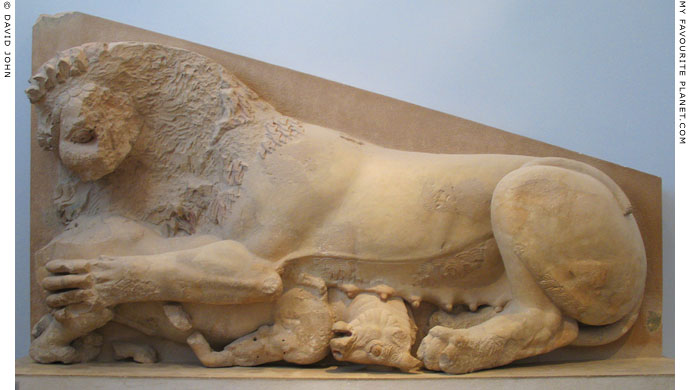
An Archaic poros (limestone) high relief of a lioness devouring a bull or calf.
Mid - late 6th century BC. Reassembled from a large number of fragments found in 1888
east and southeast of the Parthenon. Thought to be from the right side of the east
pediment of the Hekatompedon. Height 160 cm, width 322 cm; height of relief 41 - 52 cm.
Acropolis Museum, Athens. Inv. No. 4.
See other ancient Greek depictions of lions attacking bulls
on Ancient Stageira gallery, page 30. |
| |
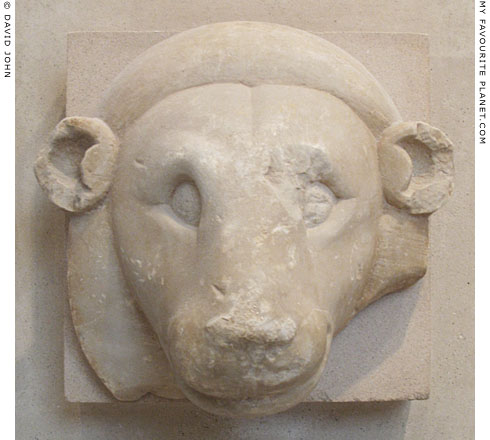
An Archaic marble lion's head thought to be from the Hekatompedon,
perhaps from a frieze or a side akroterion (see also the Gorgon statue
above). The pupils of the eyes are marked by two incised concentric
circles around a central dot.
Hymettian marble. Height 26 cm, width 28 cm.
Acropolis Museum, Athens. Inv. No. 122. |
| |
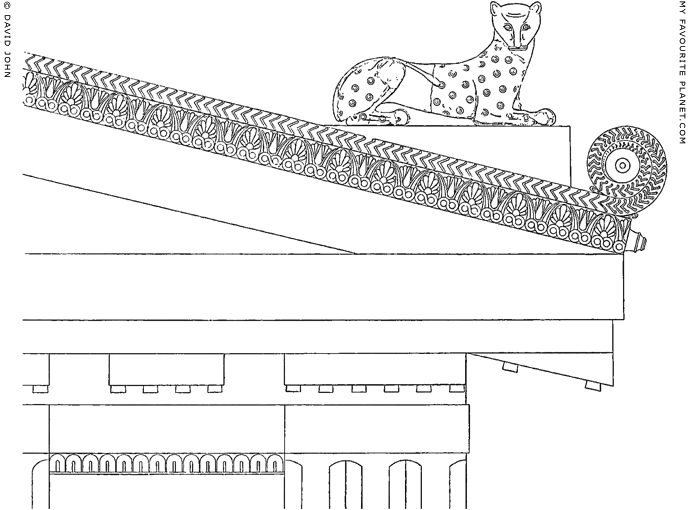
A hypothetical reconstruction of a pediment of the Hekatompedon by the German
archaeologist Johann (Hans) Hermann Schrader (1869-1948), based on several
sculptural fragments found around the Acropolis in the 19th and early 20th centuries.
|
A marble akroterion statue of a panther (or leopard) sits above the relief-decorated sima (gutter), which ends with a spiral akroterion (see photo below). Fragments of two such panthers have been restored and are now in the Acropolis Museum (Inv. Nos. 552 and 554). The cats' spots are made up of two incised concentric circles around a central dot, similar to the eyes of the lion's head above. Schrader was also responsible for the reconstruction of the fragments of a Gorgon statue as the central akroterion of the pediment (see photo above).
Source: Hans Schrader, Archaische Marmor-Skulpturen im Akropolis-Museum zu Athen,
Fig. 13. Österreichisches Archäologisches Institut. A. Hölder, Wien, 1909. At the Internet Archive.
See also the lion-panther on the Archaic Gorgon pediment in Corfu, made a few decades earlier. |
|
|
| |
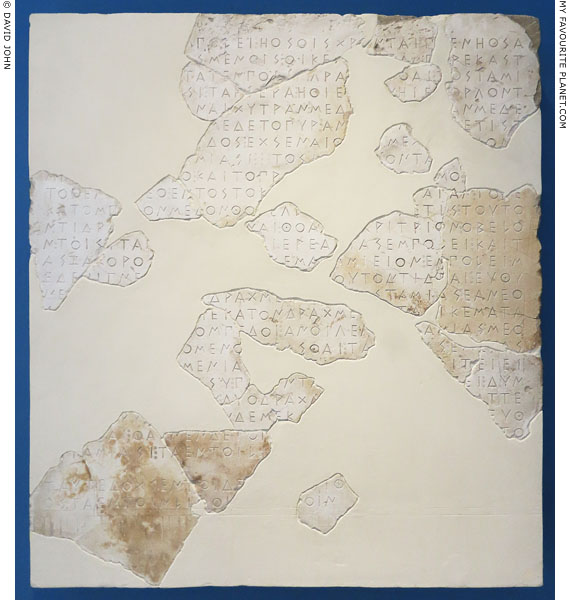
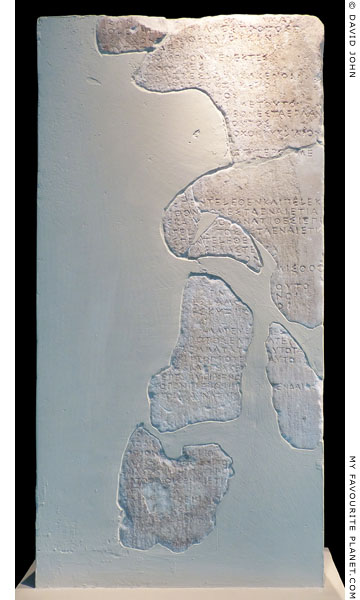
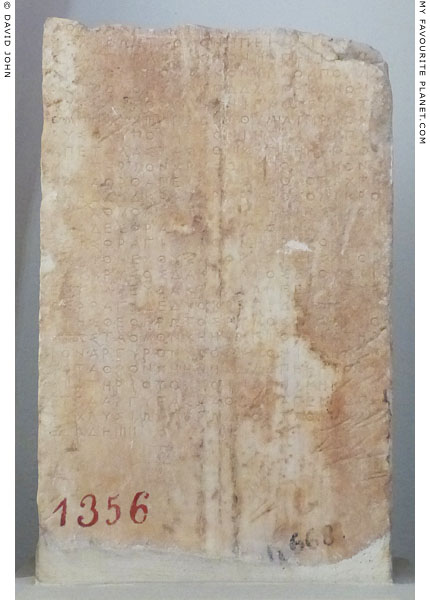
Fragments of a marble slab inscribed with the sacred law
concerning the Acropolis and the Hekatompedon.
485/484 BC.
Epigraphical Museum, Athens. Inv. No. EM 6794.
Inscription IG II³ 4b. |
| |
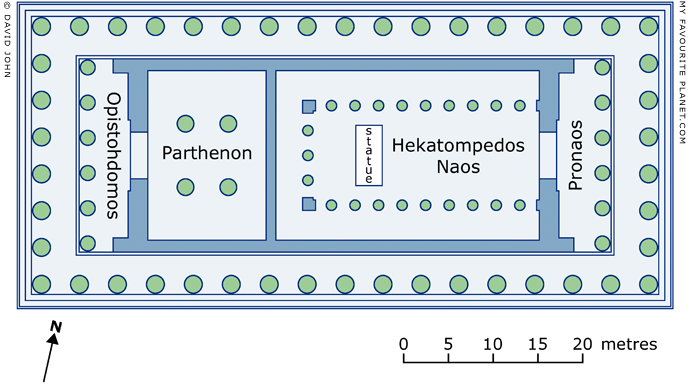
Plan of the Parthenon.
|
Pronaos (before the temple), the front porch at the east end of the Parthenon, from which a large doorway led into the cella.
Hekatampedos Naos, the cella or main chamber, in which stood the colossal statue of Athena Parthenos (see below). In the Classical period it was still referred to as the Hekatampedos (ἑκατόμπεδος, hundred-footer) after the Archaic temple (see above).
Parthenon (Παρθενών, Apartment of the Virgin), the smaller western chamber, used as a treasury in which sacred objects and the financial contributions of the Delian League were stored. The roof was supported by four tall Ionic columns. There was no doorway connecting the two chambers.
Opisthodomos (ὀπισθόδομος, back room), usually the name given to the the rear (western) porch of a temple. In the case of the Parthenon, it is thought that the Parthenon chamber was renamed to the Opisthodomos around the end of the 5th century BC (see below). |
|
|
| |
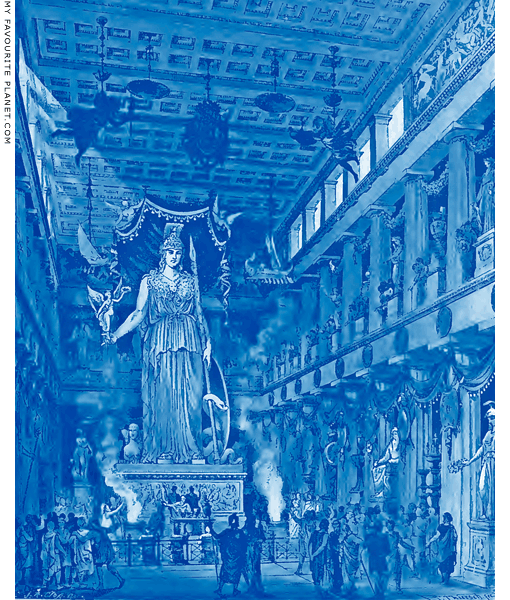
A late 19th century artist's impression of the interior of the Hekatampedos (main
chamber) of the Parthenon and the colossal statue of Athena Parthenos by Pheidias.
Illustration by Friedrich von Thiersch, published in Charlotte M. Yong, A pictorial history
of the world's great nations, from the earliest dates to the present time, Volume I,
page 89. Selmar Hess, New York, about 1882. At the Internet Archive.
|
The colossal chryselephantine (gold and ivory) statue of Athena Parthenos (Ἀθηνᾶ Παρθένος, Athena the Virgin) was made by Pheidias [4] between around 447 and 438 BC. Pieces of ivory were formed into sheets [5] and sculpted, then fitted like pieces of a three-dimensional puzzle over a wooden framework, possibly made of cypress purchased from Karpathos. Other parts of the statue were covered with gold sheets. The finished work, which stood on a rectangular base, is estimated to have been 11.5 metres tall.
The Greek travel writer Pausanias, who visited Athens in the mid 2nd century AD, gave the most extensive description of the statue of Athena Parthenos in the Parthenon:
"The statue itself is made of ivory and gold. On the middle of her helmet is placed a likeness of the Sphinx... and on either side of the helmet are griffins in relief...
The statue of Athena is upright, with a tunic reaching to the feet, and on her breast the head of Medusa is worked in ivory. She holds a statue of Victory about four cubits high, and in the other hand a spear; at her feet lies a shield and near the spear is a serpent. This serpent would be Erichthonius.
On the pedestal is the birth of Pandora in relief. Hesiod and others have sung how this Pandora was the first woman; before Pandora was born there was as yet no womankind."
Pausanias, Description of Greece, Book 1, chapter 24, sections 5-7. At Perseus Digital Library.
Strangely, Pausanias did not mention the name of the sculptor who made the statue, although elsewhere he mentioned other statues in Athens which he related were made by Pheidias. Although he described the goddess as a holding a spear in her left hand, the Varvakeion and Lenormant replicas (see below) show her holding a shield which shelters the large serpent. Modern attempts at reconstructing the statue show the spear standing between her and the shield, with the top resting on her left shoulder.
In a number of copies the goddess wears an Attic helmet. Pausanias mentions that the original was decorated by a sphinx flanked by two griffins, but the helmet of the Varvakeion statuette has three crests, supported by a sphinx and two winged horses, or pegasoi. This type of helmet also had cheek flaps (see the photo of the "Medici type" Athena, right).
See also the Athena Parthenos statue from
Pergamon on Pergamon gallery 2, page 14.
Around the beginning of the 3rd century BC, the Athenian demagogue Lachares (Λαχάρης, died around 294 BC), an ally of King Cassander of Macedonia, became the tyrant at Athens and is said to have plundered the statue of its gold and precious ornaments. He was deposed with the help of Demetrios Poliorketes, one of Cassander's successors, but fled to Koroneia (Κορώνεια), Boeotia where he was murdered.
"Lachares took golden shields from the Acropolis, and stripped even the statue of Athena of its removable ornament; he was accordingly suspected of being a very wealthy man, and was murdered by some men of Coronea for the sake of this wealth."
Pausanias, Description of Greece, Book 1, chapter 25, sections 7-8. At Perseus Digital Library.
A fire on the Acropolis in the mid 3rd century AD, probably during the Herulian invasion in 267 AD (see gallery page 6), caused damage to the Parthenon and the statue, which were later repaired, perhaps during the reign of Emperor Julian II (Julian the Apostate, 361-363 AD). In the 5th century AD the statue was taken to Constantinople along with Pheidias' chryselephantine statue of Zeus from Olympia, where they were recorded in the 10th century. They may have been destroyed when the city was sacked in 1204 during the Fourth Crusade. |
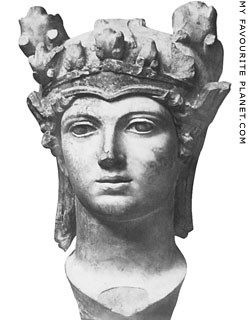
Marble head of Athena Parthenos.
Roman Imperial period. Found in
Rome in 1885. Height 35.5 cm.
Once in the Altes Museum,
Berlin (Sk 76a), it disappeared
at the end of World War II. |
| |
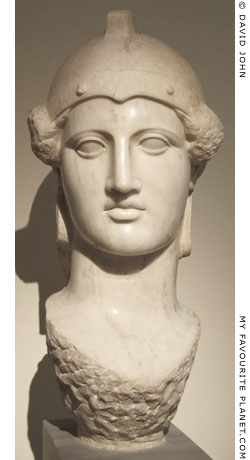
Marble head of Athena wearing
an Attic helmet, known as the
"Pnyx Athena".
Found near the Pnyx, Athens.
Pentelic Marble. Height 45 cm.
The over-lifesize head was part
of a colossal statue of the Roman
period, 2nd century AD. Thought
to be a copy of a statue by
Pheidias or one of his pupils,
probably after 430 BC.
National Archaeological Museum,
Athens. Inv. No. 3718. |
| |
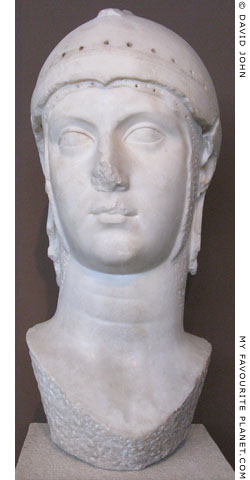
Head of Athena of the Medici type,
copied from works by the circle
of Pheidias. The goddess wears
an Attic helmet with cheek flaps.
2nd century AD. Marble, from an
acrolith (marble and wood) statue.
Found near the ancient Agora,
Thessaloniki. Height 69.5 cm.
Thessaloniki Archaeological
Museum. Inv. No. 877. |
| |
| |
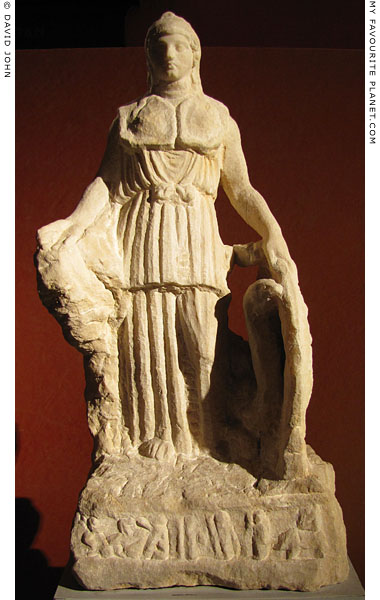
The "Athena Lenormant" statuette of Athena Parthenos,
a miniature replica of the statue by Pheidias which
stood in the Parthenon.
2nd - 3rd century AD. Found in 1859 west of the Pnyx,
Athens. Pentelic marble. Height 34 cm, with base 42 cm.
National Archaeological Museum, Athens. Inv. No. 128.
|
The "Athena Lenormant" (or Lenormant Athena) statuette has been dated by some scholars to the 1st century AD, while others believe it was made in the 2nd or 3rd century. It is named after the French archaeologist Charles Lenormant (1802-1859), who first identified it as a replica of the Athena Parthenos statue by Pheidias in 1859.
After its discovery, the statuette had been deposited in the Temple of Hephaistos (the Hephaisteion), which was then still known as the Theseion and used as a provisional museum 1834-1934 for the rapidly growing number of archaeological finds. Lenormant noticed it while visiting the temple with his son François Lenormant (1837-1883), who had accompanied him to Greece, and is said to have immediately recognized its importance. He informed the Greek government of his discovery, and Kyriakos Pittakis, Ephor of antiquities (see gallery page 12), arranged to have the sculpture photographed by the Athenian photographer Calphas.
Charles Lenormant caught a fever and died in Athens in November of the same year, and his son wrote the first description of the statuette in his article La Minerve du Parthenon, published in the Gazette de Beaux Arts in 1860.
François Lenormant, La Minerve du Parthenon. Reprint of the article in French, published by L'Imprimerie de Jules Clave, Paris, 1860. At Google Books.
The statuette is unfinished, and details such as the relief depicting the birth of Pandora on the front of the base have been crudely blocked in. The relief of the Amazonomachy (battle between Greeks and Amazons) on the shield is also rough and schematic. Although of poorer workmanship than the "Varvakeion statuette" (see below), which was discovered over twenty years later, this small sculpture was the first to provide historians with an idea of what the Athena Parthenos statue of Pheidias looked like; until then they only had written descriptions by ancient authors to go by. |
|
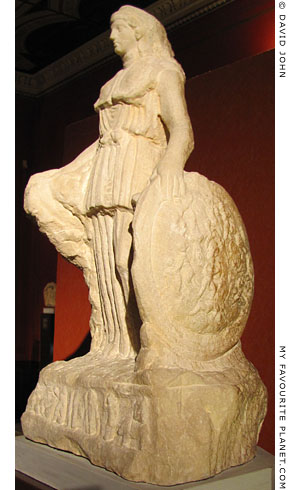
The left side of the Lenormant Athena,
showing the goddess holding the
shield with a relief of an Amazonomachy.
This photo and the one above were
taken in the Numismatic Museum,
Athens, when the statuette was on
loan for the temporary exhibition
"Myth and Coinage" in 2011. |
|
| |
 |
|
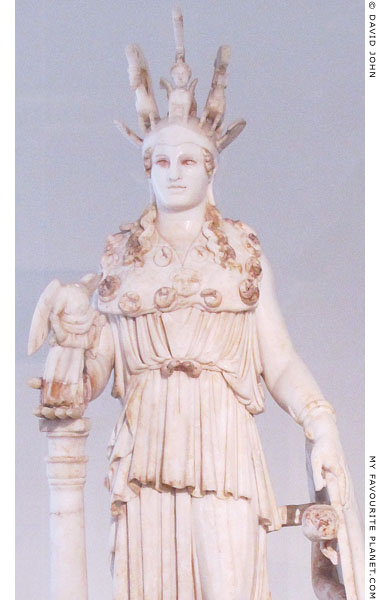 |
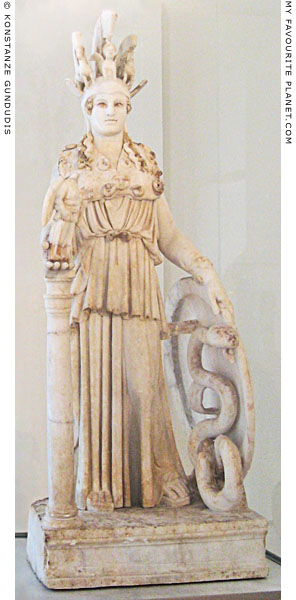
The "Varvakeion statuette" of Athena Parthenos, a miniature replica of the Parthenon statue.
First half of the 3rd century AD. Found in 1880 near the Varvakeion School,
in the suburb of Psychiko, Athens. Pentelic marble. Height with base 104.5 cm.
National Archaeological Museum, Athens. Inv. No. 129.
photo, left: © Konstanze Gundudis
|
|
Much more finely sculpted than the Lenormant statuette, this work was highly polished and painted with bright colours such as red and yellow, traces of which have survived. The sculptor concentrated more on the details of the figures of Athena, Nike and the snake, and did not concern himself with the narrative reliefs on the shield or base.
Athena's face appears rather masculine, with a broad, flat nose, and large, square chin. Her neck and arms are also quite thick. She wears an Attic helmet with three crests, the largest central crest is supported by a sphinx, and each of the two side crests is supported by a pegasus (winged horse). The cheek pieces of the helmet are raised. Hair tresses fall from behind the head onto the front of the shoulders, over which she wears the aegis, decorated around the edges with curled snakes, and fastened at the front by a Gorgoneion fibula. Her peplos is girted at the waist by a belt of two snakes knotted together. Her weight is on the right leg, and her left leg is bent so that her knee presses against the pleated peplos. Her toes and thick-soled sandals peep out from below the peplos.
In the palm of her outstretched right hand, supported by a column, she holds a small winged figure of the goddess Nike, now headless, who orginally held out the laurel wreath of victory. With her left hand she supports a standing round shield, the front of which is decorated by a relief of a winged Gorgoneion (see photo below). On the inside of the shield stands a large snake, its head facing forward and with its lower part coiled. The snake is thought to represent the oikouros ophis (ὄφις οἰκουρός, home-protecting snake), the sacred serpent which protected Athens, associated with Erichthonius (Ἐριχθόνιος), the mythical son of Athena and king of Athens (see gallery page 5, gallery page 8 and gallery page 18). |
|
|
| |
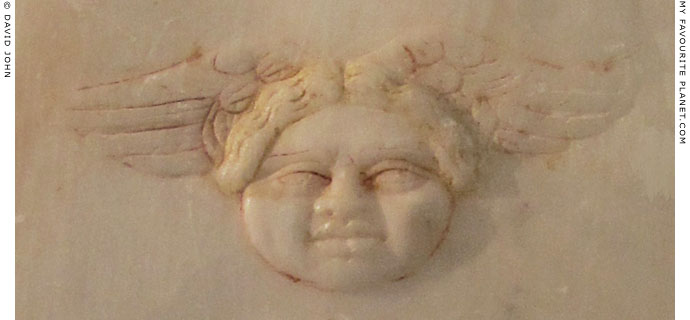
The winged, baby-faced head of the Gorgon Medusa in the centre of the shield of
the "Varvakeion Athena" statuette. Traces of yellow paint can be seen on the hair. |
| |
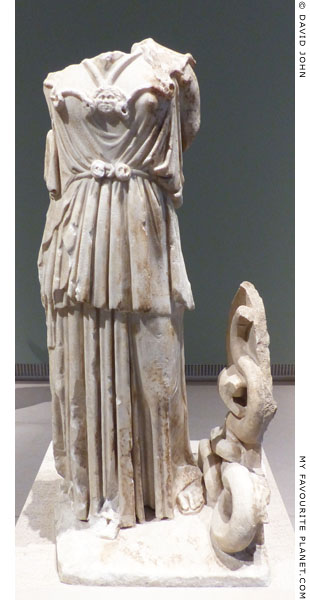
A marble statuette of Athena Parthenos, a
replica of the Parthenon statue by Pheidias.
Roman period. From Patras, northern Peloponnese, Greece.
Patras Archaeological Museum.
The head, right shoulder, arms and part of the statuette's right foot are now missing. To the right of the figure stands the shield, inside which can be seen the remains of the Erechthonian serpent. On the front of the surviving fragments of the shield itself are part of the relief of the Amazonomachy and the Gorgoneion in the centre (see photo below).
The museum labelling provides no further information about the dating, findspot or archaeological context of the statuette, and so far I have found no further literature on it. If you have more information about this statuette, please get in contact. |
|
| |
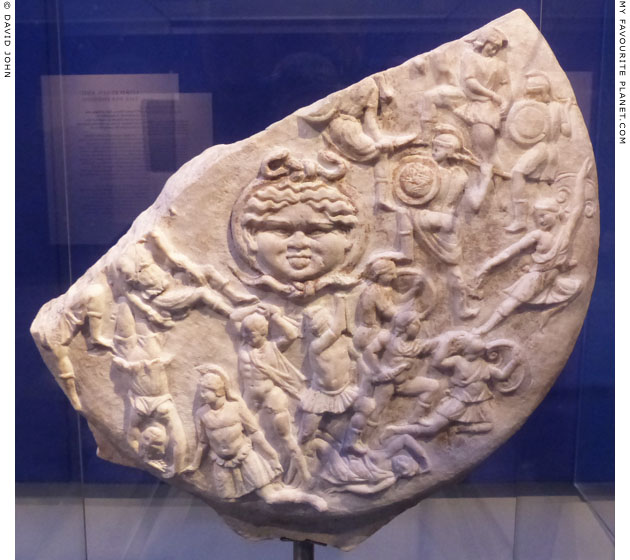
The "Strangford Shield", a fragment of a marble replica of the shield of Athena Parthenos.
From Athens, 3rd century AD. Height 43.18 cm, width 45.72 cm.
British Museum. GR 1864.2-20.18 (Sculpture 302). Strangford Collection.
|
The fragment was acquired in Athens by the British politican Percy Clinton Sydney
Smythe, 6th Viscount Strangford (1780-1855), one of the antiquities he collected
while British ambassador to Ottoman Turkey, 1820-1824. It was purchased by
the British Museum in 1864 from Percy Smythe, the 8th Viscount Strangford.
During the Roman period many copies were made of Pheidias' colossal chryselephantine (gold and ivory) statue of Athena Parthenos. The "Strangford Shield" is the only surviving part of one of these replicas. Traces of the original paint have survived. In the centre is a Gorgoneion, the head of the Gorgon Medusa. Only the front of this shield has a relief, the back is blank. Ancient authors indicate that the outside of the original shield showed an Amazonomachy (battle between Greeks and Amazons), and the inside a Gigantomachy (battle between gods and the Giants). A handful of similar fragments of such shields have also survived [6].
According to Plutarch ( Life of Pericles, 13), Pheidias was accused by enemies of Pericles of stealing gold intended for the Athena Parthenos statue, and of impiety for portraying Pericles and himself among the figures of the Amazonomachy on the statue's shield. On this replica, Pheidias and Pericles are thought to be the two men standing back-to-back below the Gorgoneion: Pheidias is the balding, naked figure on the left with an axe in his raised arms; Pericles stands to his right, wearing a helmet and armour, his left foot resting on a fallen Amazon, his right arm raised and obscuring his face. Having been warned by Pericles to carefully weigh the gold, Pheidias was able to disprove the charge of theft, but he was found guilty of impiety, and died while in prison. |
|
| |
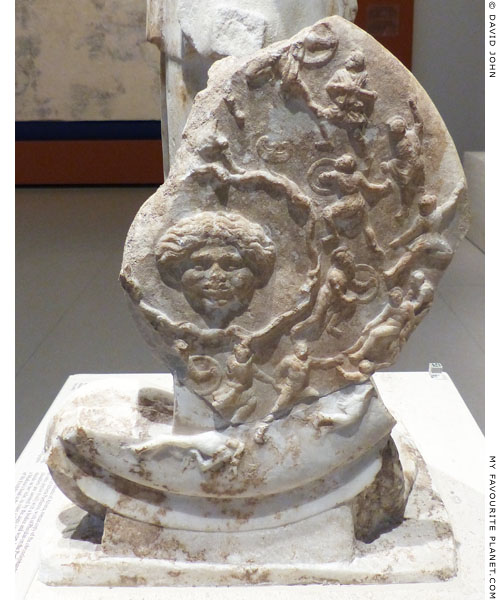
The front of the marble shield of the Athena Parthenos statuette in Patras.
The relief differs in several details from that on the larger "Strangford Shield"
(see above). Just above the ring of snakes surrounding Medusa's head is a
pelte (πέλτη), the type of crescent-shaped shield used by the Amazons.
Patras Archaeological Museum. |
| |
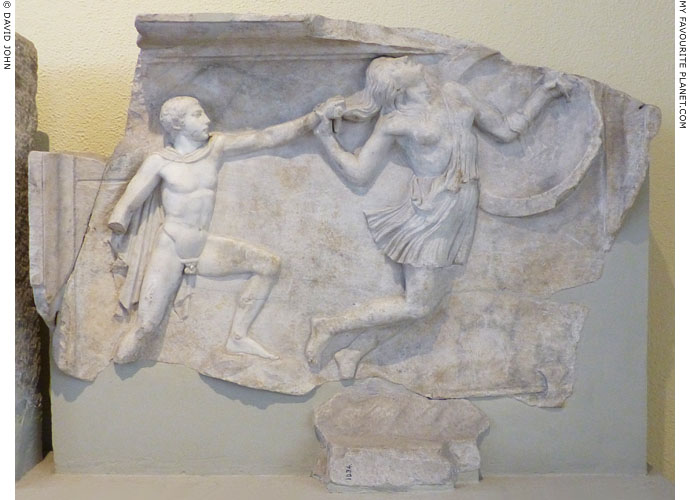
A marble Neo-Attic relief depicting a Greek pursuing a wounded Amazon, thought
to be a copy of a figure from the Amazonomachy on the shield of Athena Parthenos
made by Pheidias. Such copies of parts of the shield's composition, made as framed
decorative reliefs, were popular during the Roman Imperial period.
The dramatic scene is similar to that on the The "Strangford Shield" above.
On the left, a short-haired young Greek man, naked apart from a short cloak
covering his shoulders and back, stands behind a bare-breasted Amazon with
a round shield, and pulls on her long hair as she falls forwards, to the right.
The Greek probably held a weapon in his right hand, which is now missing.
Mid 2nd century AD. One of two almost identical plaques exhibited in the Piraeus
museum. They were among a number of reliefs (see also the photo below) and
a marble sphinx found by chance in an ancient shipwreck in Piraeus harbour
during the winter of 1930-1931. All the sculptures, apart from the sphinx, were
made in the same Attic workshop, probably mass-produced for export to Rome,
where another relief from the same workshop has been discovered.
Piraeus Archaeological Museum. Inv. No. 2115.
(The other relief Inv. No. 1834 + 2028 + 2116 + 2059.) |
| |
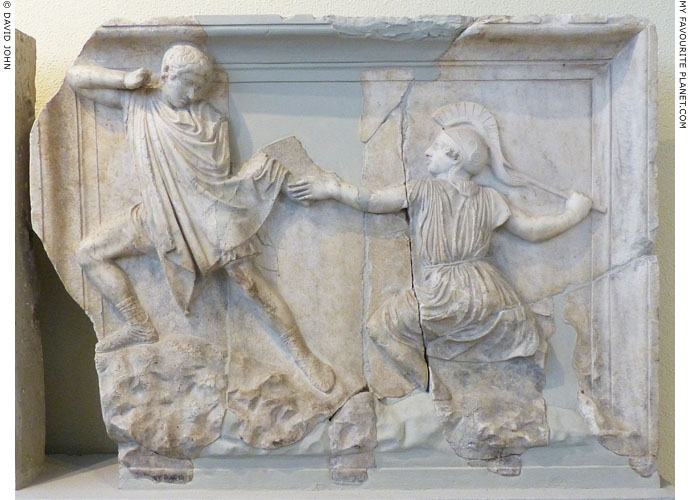
A marble Neo-Attic relief depicting a Greek fighting an Amazon,
thought to be a copy of a figure from the Amazonomachy on
the shield of Athena Parthenos made by Pheidias.
Mid 2nd century AD. The better preserved of two almost identical plaques
exhibited in the Piraeus museum, the other consists of fragments. Found
along with the relief above in Piraeus harbour in the winter of 1930-1931.
Piraeus Archaeological Museum. Inv. No. 2117. |
| |
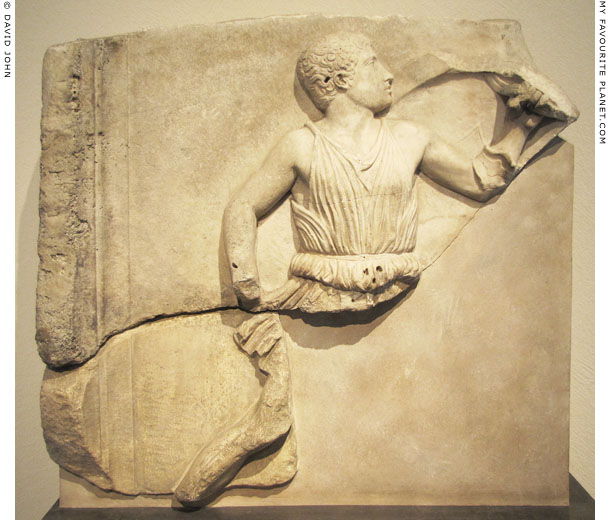
Fragments of a marble Neo-Attic relief depicting a fighting Greek,
thought to be a copy of a figure from the Amazonomachy on the
shield of Athena Parthenos made by Pheidias.
From Piraeus, around 150 AD.
Altes Museum. Berlin. Inv. No. Sk 1842. Acquired in 1931. |
| |
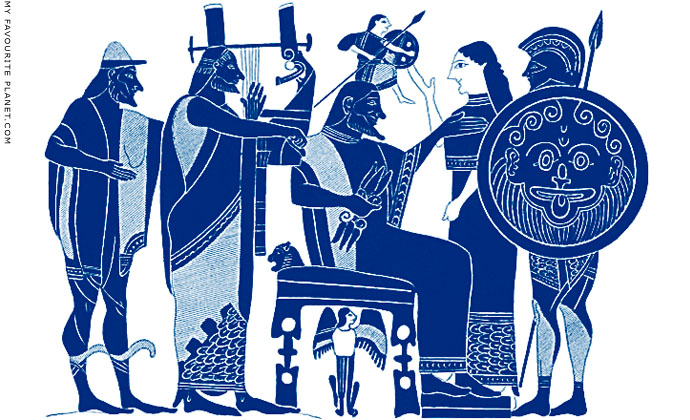
Zeus on his throne gives birth to Athena.
From an Archaic Attic black-figure panel amphora, circa 540 BC, now
in the Museum of Fine Arts, Boston. See photos at perseus.tufts.edu.
|
Athena springs "fully armed", with spear and shield, from the head of Zeus. Present to assist and cheer on with music are (left - right): Hermes, Apollo, Eileithyia (goddess of birth) and Ares. Beneath Zeus' throne is a winged figure, perhaps Nike.
Apollo plays his lyre and Zeus clutches his thunderbolt. Ares carries a shield decorated with a Gorgoneion (the head of the Gorgon Medusa, a symbol which was also to become associated with Athena, and which she is often shown wearing on her breast.
Source: lithograph made by A. Ray for Kaeppelin & Co. Published in Elite des monuments céramographiques: matériaux pour l'histoire des religions et des moeurs de l'antiquité by Charles Lenormant (1802-1859). Leleux, Paris, 1844-1861.
In the numerous versions of this scene on ancient ceramics, various figures are shown beneath Zeus' throne. The small winged figure here has been labelled as "Sphinx", though similar vases more clearly show a winged female in human form. |
|
| |
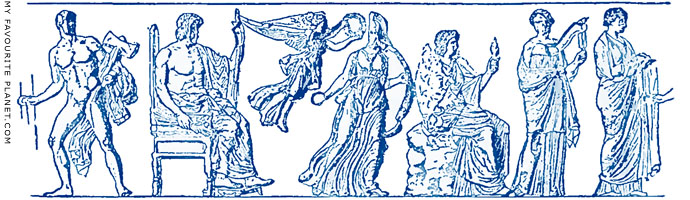
Birth of Athena on a cylindrical relief on a puteal (well-head), now in Madrid.
The marble puteal is thought to have originally been an altar, made in a
Graeco-Roman workshop. Perhaps from Rome. Height 99 cm, diameter 82 cm.
Madrid Archaeological Museum, Spain. Inv. No. 2691.
Image source: The Acropolis of Athens by Martin Luther D'Ooge, page 148.
Macmillan, New York, 1909. Drawing reprinted from Gardner's Ancient Athens.
|
Zeus, enthroned with sceptre and thunderbolt, recovers from having his head split open with a double-headed axe by Hephaistos (left), so that Athena could spring out. Nike Flies to crown the newly-born, fully-armed Athena. To the right are the three Fates: Klotho, Lachesis and Atropos.
"When by the craft of Hephaistos, by the blow of the bronze axe, Athena sprang forth from the crown of her father's head and cried aloud with a mighty shout, and Ouranos (Heaven) and Mother Gaia (Earth) shuddered before her."
Pindar, Olympian Ode 7, lines 36-38.
In other versions of this myth Prometheus, Hermes or Palamaon assist Zeus to give birth to Athena.
"I begin to sing of Pallas Athena, the glorious goddess, bright-eyed, inventive, unbending of heart, pure virgin, saviour of cities, courageous, Tritogeneia.
Wise Zeus himself bare her from his awful head, arrayed in warlike arms of flashing gold, and awe seized all the gods as they gazed. But Athena sprang quickly from the immortal head and stood before Zeus who holds the aegis, shaking a sharp spear.
Great Olympus began to reel horribly at the might of the bright-eyed goddess, and earth round about cried fearfully, and the sea was moved and tossed with dark waves, while foam burst forth suddenly.
The bright Son of Hyperion stopped his swift-footed horses a long while, until the maiden Pallas Athena had stripped the heavenly armour from her immortal shoulders. And wise Zeus was glad.
And so hail to you, daughter of Zeus who holds the aegis! Now I will remember you and another song as well."
Homeric Hymn 28. To Athena.
The Homeric Hymns and Homerica with an English Translation by Hugh G. Evelyn-White.
Harvard University Press, Cambridge, MA, and William Heinemann Ltd., London, 1914. At Perseus Digital Library. |
|
| |
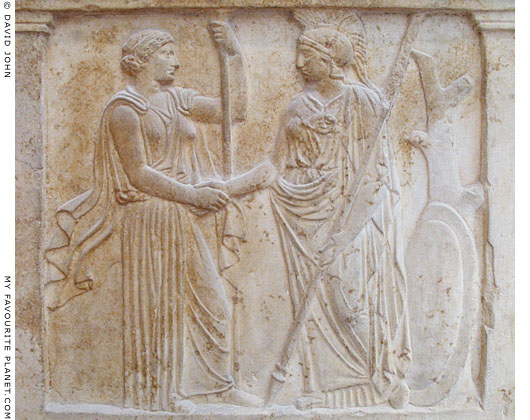
Hera and Athena, patron goddesses of Samos and Athens, clasp hands in a
relief on a marble stele of 403-2 BC, inscribed with the Samian honorary decree.
The original decree was issued in 405 BC by the Demos of Athens in honour
of the Samians for remaining loyal to them following the defeat of the Athenian
fleet by the Spartans at the Battle of Aigospotamoi and the revolt of other allies.
Found in fragments between the Theatre of Dionysos and the Odeion
of Herodes Atticus on the south slope of the Acropolis. Width 56 cm.
Acropolis Museum, Athens. Acr. 1333. Inscription IG II(2) 1. |
 |
|
|
| |
| |
 |
| |
 |
| |
 |
| |
 |
| |
 |
| |
 |
| |
George Alvanos
rooms in
Kavala's historic Panagia District
Anthemiou 35,
Kavala, Greece
kavalarooms.gr
|
| |
Papoutsis
Travel Agency
Kastellorizo,
Greece
+30 22460 49 286
papoutsistravel.gr
|
| |
|