|
|
|
| My Favourite Planet > English > Europe > Greece > Dodecanese > Kastellorizo |
| Kastellorizo, Greece |
Sightseeing on Kastellorizo |
|
 |
page 5 |
 |
|
| |

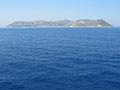
View of the north of Kastellorizo at dawn from the Turkish resort of Kaş. |
| |
Photos of many of Kastellorizo's sights with more detailed information
can be seen in the photo gallery.
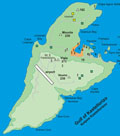
Locations of the sights can be seen on the detailed map on page 9.
The most impressive sights on Kastellorizo are the views around the island itself, the vast expanse of Mediterranean Sea, the mountainous breadth of the opposite Turkish coast and the numerous islets in between.
There is also much to be explored and discovered around the island's only settlement: the main harbour (Limani), the Kavos headland, the smaller port of Mandraki, the Horafia district and the Paleokastro (old castle).
For those arriving on a daytrip from Kaş in Turkey, ferries arrive around 10.30 am, and leave at 3 or 3.30 pm (See page 3: getting to Kastellorizo). Unless you negotiate with one of the ferry companies to stay overnight, you only have around 4 hours to explore. This gives you time to see some of the main town, maybe visit the two small museums, the Lycian tomb and Knights' Castle.
Summer temperatures can reach 45 degrees celcius, so rushing around is nuts. At sunset, mad joggers run up the cliff stairs in about 10 minutes. When they reach the top, they bravely try to look as though they are not really about to have multiple organ failure. Normal mortals take much longer, and although the views from the top are wonderful, the slog is not recommended in the midday heat. The ever-uphill walk to the ruins of the Paleokastro (old castle) can also be strenuous and time-consuming. |
| |
| |
Kastellorizo
sights |
The main harbour:
the west side, Pera Meria district |
|
 |
|
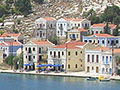
Colourful old houses along the quayside, including the "blue house" (also known as "Mediterraneo house") which featured in Gabriele Salvatores' 1991 Oscar-winning Italian war film "Mediterraneo". On the hillside behind is the Italian built Caserma barracks, now a pension.
The Gazadika, the chapel that never was.
Megisti Hotel, the modern low-rise municipal hotel.
Police station and post office, built by the Italians in 1928 as the carabinieri barracks and radio station. |
|
gallery pages
68 - 81 |
|
| |
Kastellorizo
sights |
The main harbour:
the centre of town |
|
|
|
When does a village become a town? In the case of Kastellorizo, with its village atmosphere and permanent population of 492, the answer is in Summer, particularly July and August when the tourists and the people who serve them are here in force.
Behind the harbour-front restaurants, bars and shops are the town's narrow backstreets.
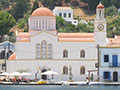
Agios Georgios Tou Pigadiou (Saint George of the Well), late 19th century church on the harbour front.
Australia Square, in front of the church. Dedicated to the country where many islanders emigrated after World War II. Ex-pat "kassies" and their descendants retain close ties with the island. See, for example, australianfriendskastellorizo.org.
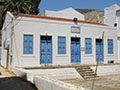
Nikolaos Stamatiou primary school, opened 1903.
The municipal bakery (Demotikos Fournos), source of the island's freshly baked bread, pastries, sweets and cakes. Get there early, and take away a tasty tyropita (cheese pie) or spanakopita (spinach pie) as a snack on your wanderings.
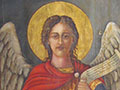
Agios Merkourios (Saint Mercourios), a late 18th century church at the southwest of the town, restored in 2008.
The Nea Agora (New Market; Italian, il Nuovo Mercato coperto, the New Covered Market), the Italian Colonial style market hall on the southeast corner of the main harbour, was built by the Italians in 1934 for the sale of fish, meat, fruit and vegetables. Behind it is a cool, shaded courtyard with a taverna, a general store and a gift shop. |
|
gallery pages
83 - 141 |
|
| |
Kastellorizo
sights |
The main harbour:
the east side |
|
|
|
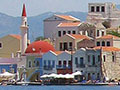
Continuing from the centre of Kastellorizo town, the east side of the harbour was once home to the island's wealthier citizens, and its commercial and social centre. This area suffered the worst destruction in July 1944 when a fire at a fuel dump spread to an arsenal and destroyed half of the island's homes.
Many gaps lie between the once densely packed hillside houses, and the remains of some surviving buildings on the narrow stepped streets are slowly being reconstructed and renovated.
The east side of Kastellorizo's main harbour lies on the Kavos headland which separates it from the smaller Mandraki harbour further east.
At the far end of the harbour, on the northwest tip of the Kavos headland, are a collection of historical monuments, including the Municipio, the Ottoman Mosque and the Delegazione Del Governo. |
|
gallery pages
142 - 174 |
| |
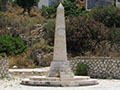
Monument to the Unknown Soldier
The cenotaph (κενοτάφιον, kenotaphion, empty tomb), in the form of an obelisk, stands in a large square formerly known as Mesi tou Yialou (the middle of the harbour) which was the island's social and commercial centre before the destruction of the Second World War. |
|
gallery page
155 |
| |
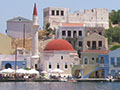
Nikolaou Savva Square (also known as Kavos Square)
The administrative centre of Kastellorizo, on the northeastern tip of the main harbour, was renamed after local hero Nikolaos Spyridonos Savvas who was killed by the Germans on Rhodes in 1942. |
|
gallery pages
158 - 174 |
| |
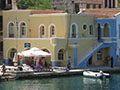
The Municipio
The colonial style municipal building on Nikolaou Savva Square was built by the Italians between 1932 and 1933 to house the post office, customs house and harbour master's office.
Today it is home to the municipal chambers (town hall), the Port Authority and the Hellenic Coast Guard. |
|
gallery pages
158 & 159 |
| |
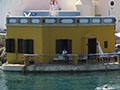
Delgazione Del Governo (Dioikitirio, Faros Bar)
Designed in 1926 by the architect Florestano di Fausto (1890-1965) as offices for the delegation of the Italian governor of the Dodecanese, Mario Lago (1878-1950) who ruled from Rhodes. Originally three storeys high and painted deep red, it was badly damaged in 1941 during a battle between the Italian navy and British commandos who had occupied the island.
Today the remaining single storey houses the popular Faros Bar. Faros is Greek for lighthouse, and indeed there is a navigation beacon on the bar's roof. |
|
gallery page
158 |
| |
The Ottoman mosque, now the Cultural Museum
Opening hours: Tue - Sun 8.30 - 15.00 hours.
Mondays closed. Entrance free.
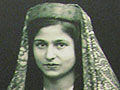
The mosque, built by the Turkish architect Osman Agha in 1753, was renovated and opened as a cultural museum in 1997. Officially known as the Historical Collection of Kastellorizo, displays local costumes and crafts as well as images, information and a multimedia presentation about the island's history. |
|
gallery pages
163 - 174 |
|
| |
Kastellorizo
sights |
East of Kastellorizo's
main harbour |
|
|
|
The Kavos headland
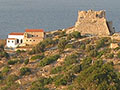
Beyond the east side of the main harbour, around the northern end of the Kavos headland, are the Lycian tomb, the Archaeological Museum, the twin churches of Saints Nicholas and Dimitrios, the Knights' Castle, a hamam (Turkish bath) and 18th century windmill. |
|
gallery pages
175 - 222 |
| |
The Lycian style tomb (4th century BC)
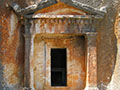
The Lycian rock-cut tomb, with its Doric facade carved out of the rockface directly below the Knights' Castle, is the only one in Greece.
It is a 5-10 minute walk along a paved coastal footpath from the mosque. The path has great views of Psoradia islet and the Turkish coast. Along the way there are sets of stone steps, and the climb to the tomb itself is up steep, narrow stone steps. Unfortunately, the ancient Lycians had no concept of disabled access. |
|
gallery pages
175 - 184 |
| |
Kastellorizo Archaeological Museum (Museum of Megisti)
Tel: +30 22460 49283
e-mail: efadod@culture.gr
Opening hours: Tueday - Sunday 8.30 - 15.00 hours.
Mondays closed.
Tickets €2, reduced €1
You can walk to the museum by a stepped path near the Lycian tomb or directly from the east side of the harbour.
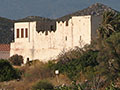
Known as the "Konaki", the small fortress with crenellated battlements and courtyard were part of the Medieval Castle of Agios Nicholas (Άγιος Νικόλαος), in Kastellorizo's fortified precinct, just below the Knights' Castle (see below). It was used by the Ottoman Turks as the governor's headquarters and a barracks.
After World War II it remained abandoned until it was converted into a museum in 1984. It displays a small selection of Classical and Helllenistic finds, Byzantine pottery, an icon of Saint George and the dragon as well as cultural artefacts such as a sponge diver's suit. Most remarkable are the very rare Lycian style votive reliefs. |
|
gallery pages
185 - 203 |
| |
The Castle of the Knights of Saint John
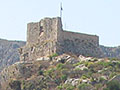
The Knights of Saint John (also known as the Knights Hospitaller) took over the island in 1306, as part of their military campaign to take Rhodes from the Turks, and built their castle between 1379 and 1383. The ruins of the tower are only half of its original height, and are just a small part of the knights' fortifications. Still, good view from the top.
Nearby are the the twin churches of Saints Nicholas and Dimitrios, as well as the remains of a small hamam (Turkish bath), a windmill, a Turkish school and various later military buildings. |
|
gallery pages
204 - 222 | |
| |
Kastellorizo
sights |
Mandraki and Horafia |
|
|
|
To the east of the main harbour
Mandraki harbour
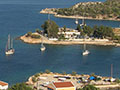
Kastellorizo's second, shallower, more tranquil harbour, used for boat repair, and formerly for the production of charcaoal made from timber shipped from Turkey and then exported to Egypt and the Levant.
There are a handful of houses, two churches (Agia Parakevi and Agios Savvas) and the island's cemetery. |
|
gallery pages
223 - 227 |
| |
To the southeast of main the harbour
Horafia (fields) district
As its name indicates, Horafia, to the west of Mandraki harbour, was once an area of cultivated fields which became built-up during the 19th century as the island's population and economic fortunes grew.
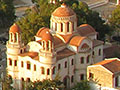
The small district is Kastellorizo's religious and cultural centre, and has four churches and two schools.
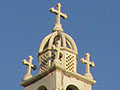
The island's cathedral Saints Constantine and Elena (1835) with its fancy belltower and columns pilfered from the ancient Lycian city of Patara, the neo-classical Santrapé Town School (1903) and the humbler Parthenagogeion (girls' school, 1905) were all built around Avlogyro Square which has a choklakia mosaic floor.
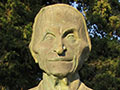
Nearby, on Panagia Square are the early 19th century churches Panagia and Saint Spyridon, a monument to local heroine Despina Achladiotou ("The Lady of Ro"), the unfinished Saint George of the Fields church (1904) and a monument to island benefactors Loukas and Anastasia Santrapé.
Taverna Mediterraneo on Panagia Square offers homemade Greek dishes (see page 4: activities - eating and drinking). |
|
gallery pages
228 - 243 |
|
| |
Kastellorizo
sights |
Above and beyond
Kastellorizo town |
|
|
|
To the southeast of main the harbour
Up the cliff
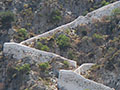
A good way to get up an appetite for your evening meal is to walk the 400 or so steps up to the top of the cliff just south of Kastellorizo harbour. Don't forget to take water: the steep climb is thirsty work.
When you get your breath back at the top, enjoy the view across the island and the Mediterranean, and take in the sunset over the Turkish coast.
If you don't fancy climbing up the stairway, the top of the cliff can also be reached by the road out of town, west of the harbour, towards the airport and Paleokastro ( see below). The path to the east of the Paleokastro and behind (south) of the summit of Mount Vigla leads to the high centre of the island and Mount Vouno, the second highest peak. |
|
gallery pages
244 - 257 |
| |
To the southwest of main the harbour
Paleokastro (Παλαιόκαστρο, Old Castle)
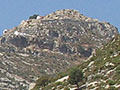
Just to the south of the main harbour a road leads west towards the airport and the island's highest peak Mount Vigla (273 metres), which is crowned by communication and radar towers and a chapel. On a lower hilltop to its west is the ancient Paleokastro, the ruins of which have also been cluttered with Christian chapels. Nearby is the monastery of Saint George of Vounion (Άγιος Γεώργιος του Βουνιού, Agios Georgios tou Vounio), also known as the Vounio (ή Βουνιού), in which is the catacomb of Saint Charalampos (Άγιος Χαράλαμπος). |
|
gallery page 15 |
|
| |
Kastellorizo
sights |
Around the coast of Kastellorizo |
|
|
|
The east coast of Kastellorizo
The Blue Grotto or Blue Cave
Like many localities on Kastellorizo, the Blue Grotto (Γαλάζια Σπηλιά, Galaxia Spilia), on the southeast side of the island, has more than one name, and is also known as the Parasta sea cave (Σπηλιά του Παραστά, Spilia tou Parasta) or Fokiali (Φώκιαλη). It can only be reached by boat during calm weather (see page 4: activities for details of local cruise boats). It is best visited early in the morning when the refracted sunlight turns the seawater inside the cave into a deep glowing blue.
At up to 50 metres long, 30 metres wide and 25 metres high, it is larger than the famous Grotta Azzurra on the Italian island of Capri. It takes about 20 minutes to reach the cave by boat from Kastellorizo harbour. Passengers have to duck to avoid banging their heads on the top of the low cave entrance as the small cruise boats enter. Once inside there is plenty of headroom, and some like to swim in the eerily coloured seawater. |
|
|
| |
Nearby islands
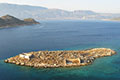
The several small Greek islets around Kastellorizo, such as Psoradia (right), are ostensibly unpopulated, although some are occupied by soldiers defending these remotest Greek territories.
Many of the islets, inculding Ro and Stroggyli, can be reached by daily cruise boats and water taxis from Kastellorizo's main harbour (see page 4: activities for details).
As there are no faciliities on any of these islands, you should take your own food and water. |
|
gallery pages
60 - 62 |
| |
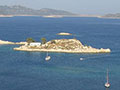
On the islet Agios Georgos, just off Mandraki harbour, stands the small church of Agios Georgos tou Nissiou (Saint George of the Island). There is also a small beach, and it is a popular place for swimming and snorkling. Reached by a daily water taxi service from Kastellorizo's main harbour (see page 4: activities for details). |
|
gallery page 224 |
| |
Ro (Greek Ρω, Turkish Kara Ada - the black island)
Around 7 kilometres west of Kastellorizo, Ro's main claim to fame is that it was home to local heroine Despina Achladiotou, "The Lady of Ro" (1898 - 1982). See a photo of her statue in the Horafia district on gallery page 238. Despina and her husband farmed and kept goats on Ro. She refused to leave the island even after the death of her husband and defiantly raised the Greek flag every day. As well as her tomb there is also a Hellenistic fortress. According to the 2001 Greek census Ro has a population of 15. |
|
gallery page 238 |
| |
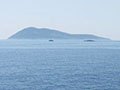
Stroggyli (Greek Στρογγυλή Μεγίστης, Turkish Çam Adası)
Stroggyli (also known as Strongili or Ipsili), around 7 km southeast of Kastellorizo, is the easternmost Greek Territory, and its lighthouse has the distinction of being the easternmost building in Greece.
It is approximately 1.5 km long and up to 700 m wide, covering an area of about 0.9 square km. According to the 2001 Greek census it has a population of 9.
See photo on gallery page 10. |
|
gallery page 10 |
|
| Further information about Greece can be found in our introduction to Greece. |
Maps, photos and articles: © David John,
except where otherwise specified.
Additional photos: © Konstanze Gundudis
All photos and articles are copyright protected.
Images and materials by other authors
have been attributed where applicable.
Please do not use these photos or articles without permission.
If you are interested in using any of the photos for your website,
project or publication, please get in contact.
Higher resolution versions are available on request.
My Favourite Planet makes great efforts to provide
comprehensive and accurate information across this
website. However, we can take no responsibility for
inaccuracies or changes made by providers of services
mentioned on these pages. |
|
| |
 |
Visit the My Favourite Planet Group on Facebook.
Join the group, write a message or comment,
post photos and videos, start a discussion... |
|
|
| |
|
|
| |
| |
Papoutsis
Travel Agency
Kastellorizo,
Greece
+30 22460 49 286
papoutsistravel.gr
|
| |
 |
| |
 |
| |
 |
| |
 |
| |
 |
| |
 |
| |
George Alvanos
rooms in
Kavala's historic Panagia District
Anthemiou 35,
Kavala, Greece
kavalarooms.gr
|
| |
|